Have I Seen The Future? As We All May, Were We Paying Attention

I have pretty strong recollections of arriving in these parts in March of 1968 and feeling that BC was a couple or three decades behind my former California digs, behind in crime, behind in grime, behind in overconsumption and bluster. OK, no more Fillmore/Avalon Ballroom/Straight Theater dance-concerts and no more free wheeling social life in the way it was practiced in marvellous Marin and in the Marina district. I also recall that, not long after, I thought it might be an idea to actually walk the five miles to school one lovely morning, and that said walk took longer than it might otherwise have because Saltspringers at the time didn’t see that walking was a viable mode of transportation and would pull over to offer a ride (“Hey, aren’t you one of the new kids? Lemme give you a lift…”), and where there were several versions of shaking heads that a teen would actually walk rather than get a ride right to the front door of the school. The community ran the gamut from the hip and out there to the real estate developing movers and shakers, but there did seem to be a very sense of community and a willingness to help others where the need arose. Saltspring Island, along with most of the East Coast of Vancouver Island, the Sunshine Coast and the Salish Sea generally have gone the way of Marvellous Marin, becoming a mecca for money from elsewhere, a locus of gentrification, and, in a way, a mirror of a society that has seriously lost its way. In the same way, our Canadian society has caught up with much of the mean-spirited social Darwinism of our friends to the South, and much of this is reflected in the state of our cherished community institutions, health care being a prime example.

We love you, especially your wallet.

We love you, especially your wallet.

A recent look at some time-shifted television from Detroit gave rise to some reflection on what health care will look like in a short time if we continue along our current path to reinserting greed into the equation. Every break for ads contained at least one, and often several, spots for health-related items. Some of these were prescription medications (“Talk to your doctor about adding Rigormortis.”) but many were for actual hospitals and their associated health management companies. I don’t even want to know what it costs to advertise on network television, even in a depressed market like Detroit, but it must be substantial, and some of the outfits aren’t even located in Detroit–In one instance, it is suggested that you make the trek to Chicago to treat your cancer. In one half-hour, there must have been at least a dozen of these slick presentations. It’s plain that a good portion of the health dollars spent in the U.S. (read private medical care systems) goes to promotion. There is also all the paper shuffling, apparently a much steeper cost in the U.S. than in more social jurisdictions, and, finally, beyond the salaries for highly trained professionals, there is the cost of hiring the best and brightest administrators of corporate health management organizations and a dime or two for shareholders. The Affordable Health Care Act is but a timid step is a vague approximation of the right direction, and, oh! my, what a fuss it has caused among the fans of Tea and the Fraser Institute, excuse me, Heritage Institute zombies loose on the streets of Laredo. And here in the land of Canuckistan, where socialism runs rampant, there are signs that we’re headed very much the way of the good ole boys who shoot ducks. That same Fraser Institute published a report yesterday bemoaning the increase in the interval between diagnosis by a generalist and treatment by a specialist, noting that said interval had pretty much doubled since 1993, and that Canadians should get accustomed to a more innovative system (code for a privatized, for-profit system). Ironic that they should cite 1993 as a baseline. Oh, yeah, it’s a nice, round 20 years, but it also marks the coming to office of one Paul Martin as finance minister, whose desire to slay the deficit outweighed such promises as scrapping NAFTA, reversing the GST and killing the helicopter contract. Martin did in the deficit, but mostly at the cost of services to the general citizenry, returning less money to provinces for health and education, for housing and social programs, a canon right out of the FI playbook. And now, behold, we have a proliferation of advertising on Canadian media about insurance to cover items not paid for by general health care, where Blue Cross will, for a monthly premium, pick at least part of the tab for any comely young woman who happens to get bitten in the butt by some stuffed toy in unlikely circumstances. It gives me this sinking feeling that we are looking at another of those altered baselines, where we get Mike Duffy’s and Pamela Wallin’s expenses, expensive military hardware of dubious usefulness, a surveillance state only slightly less imposing than the NSofA, but poverty and illness on reserves and in city cores, closed public hospitals, schools of increasing irrelevance, and a parliamentary system that is crumbling under Con attack.

If you don’t see this blossoming right before your eyes, save up some coin and see your nearest political ophthalmologist.

This little video is pretty enlightening:

https://www.upworthy.com/his-first-4-sentences-are-interesting-the-5th-blew-my-mind-and-made-me-a-little-sick-2?c=upw8

Step On the Assembly Line, Pay First At The Door

Step On the Assembly Line, Pay First At The Door

Trade Expansion

Small, but effective, rogues' gallery.

Small, but effective, rogues’ gallery.

CETA: CEE TA look of Canada as it disappears off in the distance. This treaty has little to do with putting Canadians to work, and less yet to do with the prosperity of thee and me. It aligns us with the European Corporate Bureaucrats, meaning that everything will likely continue to get more expensive, and that control over pharmaceuticals and water will disappear entirely as the NAFTA-Chapter 11-style investor state relations clauses are invoked to override any sort of local control over economic issues. Along with the loss of economic autonomy goes the consequent loss of sovereignty as Canada slides to the bottom of the corporate client chasm. Harper, as usual, is sanguine in his expectations for the results of this agreement, as he is for the China-Canada FIPPA and the TPP, and well he should be as he ensures that the economic cupboard for Canada is entirely bare before he makes an exit for his beloved USA, where he counts on joining the winners’ circle in the economic game with the wealth and status conferred on elder statesmen and economic stooges.

And, no surprise, no one in the usual press sources has much to say about the downstream effects of this abomination, other than to mention changes in cheese quotas and the increased freedom of beef farmers to export into the EU (they don’t seem to have noticed that EU producers are already going down in droves in affluent jurisdictions as poorer Eastern producers undercut  labour costs and sidestep inspections. Same old crap as  FTA and NAFTA. Have fun, boys and girls.


Dissonance

Heads up! Here comes the bullshit ball!

Heads up! Here comes the bullshit ball!


The feces seem to be splattering lightly off the blades of the fan in official circles as Canadian monitoring agencies appear to have hacked into servers in Brazil’s ministry of mines. First, Carol McNeil invited a former CSIS director to give his perspective, which predictably turned out to be a thin justification under the heading of a paper exercise where our boys were gaming a terror threat. Spin and damage control filled the screen with nary a challenge from Ms. McNeil. This was followed by a clip from Mr. Harper where he assured us that the government doesn’t share intelligence with private concerns, say, mining companies or energy consortia. It set off a bit of an alarm in that, quite recently, it was revealed that considerable government resources were being directed to the support of a series of energy projects as they move through the permitting process: if actions speak more loudly than words, we would have to assume that there is a good chance that the government is involved in wholesale industrial espionage for the benefit of Canadian business. This is surely jumping to a conclusion, but it’s plausible, and given the government’s record on truthfulness and forthrightness, there seems to be little that emanates from official Ottawa that is worth much trust. It’s particularly amusing to watch the crocodile tears over the damage to the relationship between the two countries (first think Embraer and Bombardier), and to absorb the faux contrition from Mr. Harper as he bemoans what will surely be a loss of faith in Canada’s goodwill. It’s like the husband who had a fling and got caught (no preemptive confession here) but assures his wife that it’s not official policy, or that it’s someone else’s fault. Too bad that the follow-on is likely to fall off the press cycle pretty quickly as back-channel chocolate and roses are laid on to patch up the marriage and ensure that business can go on as usual.


Spy-vs-spy

Investing In Their Future, Not Ours

Get Some Of That Overseas Booty

Get Some Of That Overseas Booty


Mr. Harper is crowing ( and I can’t even imagine Christie’s twisting and twerkings at this news) over the Petronas announcement that they will invest a total of $36 billion to build an LNG facility and associated infrastructure here in BC. Setting aside considerations of the fried planet with continued burning of fossil fuels, setting aside the devastation of hydraulic fracturing with its negative impacts of both land and water, not to mention the possibility of poisoning from sour gas, set aside the considerations of the corruption in the political and economic systems, and let’s talk about what investment really is in this context. Simply, it’s that we are unwilling to invest in our own economy, so we bring in the outside money, money that has a price. Not only does this take us back to the days of hewers of wood and drawers of water, it ensures that the best of the value generated by local activity ends up in Kuala Lumpur. This situation is particularly acute in the face of an administration that refuses to invest in a truly sustainable future by creating local capacity to employ our own citizens to provide for our own needs before we go off to look after the needs of shareholders in the international commodities market. For every $30 billion that comes into the country, we can count on that much leaving the country in short order, along with a premium for profit and the damage to the local landscape for which no one will be responsible under the current system of privatizing profits and socializing costs. Mr. Harper will just tell us to suck it up and either ignore what we can’t see or pay ourselves for his gifts to investors. My capitalist friend wags his finger at me and tells me that this attitude ensures that nothing will ever get built and that we will languish in the dark and twiddle out economic thumbs, that there is no prosperity without foreign investment. So far, based purely on my own narrow (but long time) observations, we’re headed that with the investors, so I don’t see that there’s a lot to gain. Saint Ronald Reagan’s Shining City On The Hill is a chimera populated only by those ranked bishop and above, or whatever the secular equivalent might be, leaving the rest of us to toil in obscurity and frustration. When investment becomes mostly local and supportive of people, I’ll be on board. In the meantime, I’m probably headed for some metaphorical equivalent of Lampedusa.

Send In The Clowns

Un Clown peut en cacher un autre!

Un Clown pet en cacher un autre!

Had a chat with a friend about how Berlusconi can send the whole Italian government down the crapper when he, and probably a good number of his colleagues ought to be locked up and forgotten. Yet somehow, he retains office and influence al out of proportion to his contribution to society: some folks there seem to identify with him even though they are most likely among his victims.

Loose lips, and all that.

Loose lips, and all that.

Of course the Italians have no corner on the idiocy in politics market, and a swing through Washington these days is likely to be good for a few guffaws before the spate of tears that must inevitably follow, given the consequences of the lack of substantive action in the face of impending disaster. It’s not just Ted Cruz reading Dr. Seuss (you can almost hear the Seussian spirits gagging in the next dimension), but the whole notion that the peoples’ business can be stopped dead in its tracks by the collection of louts that sits in those august chambers is beyond ridicule and goes a long way toward explaining why nothing has been done about climate change, about oil spills and the devastation of water resources through tracking, the sacking and pillage of the economy by the sponsors of said louts, who mostly hail from Wall Street, the crisis, not only of health care, but of health itself, brought on by our inability to tell ourselves the truth about diet, medication, exercise and the spare parts philosophy of care.

Innocent-looking fellow, don't you think?

Innocent-looking fellow, don’t you think?


Caped Cruzader? Cruz Missile? Here is another man whose message is hidden behind the rhetoric of individual freedom. The unstated and sinister part of the message is that he protects his own freedom to plunder at the expense of the freedom of millions of fellow citizens, and he has a lot of company.

It’s everywhere: the Olympic torch has left Greece headed for Sochi, for a winter pageant to be held in a place with a sub-tropical climate, and where the vultures have moved in to boost the cost of hosting the event to something in the $50 billion range, according to recent reports on CBC news.

The government in Ottawa is removing the culture of medicinal marijuana from small operations run by individuals and is putting it in the hands of large corporate concerns. It will be interesting to see if the Bronfman clan gets in on the action. This looks from the outside as an invitation to graft and corruption where the current group in Ottawa are running like hell to catch up to the crew in Washington.

Go find a copy of Stephen Bruton’s song “The Clock”: it’s ticking, you can hear it every time you contemplate the direction set by leaders in all levels of political and corporate governance. What did Frank Zappa say about stupidity? That there’s more of it in the universe than hydrogen, and that it has a longer shelf life….


More Misdirection


Journo

This pic is from:
http://suttonhistoricalsociety.blogspot.ca/2011/08/small-town-newspaper-news-opinion.html


Small town newspapers can be charming, a little quaint, terribly parochial and downright ridiculous when they try to be something other than a small town paper. Our local paper is right in line with most of this: they’re essentially a mouthpiece for the local chamber of commerce types, heavy on gossip and filler from sources from farther away, including most of the editorials, pretty much all of which parrot the editorial stance of the parent company, that being, don’t risk annoying anyone who might buy advertising, and besides, we want to be on the side of the economic winners.  I’m saying this for a couple of reasons: 1) it’s very difficult for dissenting opinions to get published, even in the letters section of the editorial page, and, once labeled a dissenter, nothing gets into the paper, even completely non-controversial material relating to community cultural activities, and 2) anything is an excuse to sling more advertising, in whatever guise it may appear.

As to the first reason, I was a little taken aback to hear my wife mutter something about having the wrong last name in response to some item she thought ought to be highlighted in the letters column, and that she was going to write. I guess some of the bitter tone might have been directed at me for pissing off the powers that be, but she was also certainly lamenting the difficulty of getting anything with our last name past the gatekeepers at the editorial desk. I guess that might have something to do with my writing here occasionally, and in full knowledge that it’s about as likely to be read as it would be in the local paper, with the one consolation that it isn’t likely to be a bed for budgie droppings or a wrap for dead fish.

But here’s the killer: yesterday was deemed Raise-A-Reader Day to promote literacy, and the town notables were on the street soliciting donations for local literacy initiatives but, strangely, handing out copies of a rag from the bigger town 80 kilometers to the South and East (said paper being in some foo-doo for a second incidence of publishing material deemed by local First Nations to be blatantly racist). As well, the local had an insert devoted entirely to supporters of literacy, with a few nice pictures, a little bit of text and captioning, but you’ll have intuited that most of the space was taken up by advertising for those staunch business supporters of literacy who, coincidentally, would like us to drop by and leave behind some cash, while we’re at it. My literacy training tells me that there’s a lot less interest in literacy than in business, and I keep wondering why I deem it my civic duty to subscribe to the local paper, because, frankly, I only get from it the gloss that tells me what the parent company wants me to think is news. Newspapers are becoming irrelevant because they are patently not what people want them to be, or at least need them to be, that is to say, distributors of information and forums for real debate. Perhaps time to let the subscription lapse and redirect the funds to real journalists. Just as an example, have a look at Bob Mackin’s piece about the same event under discussion here:

http://2010goldrush.blogspot.ca/2013/09/raise-reader-rouse-adman.html


Tilting at Windmills?

Art by:http://leventep.deviantart.com/art/Don-Quixote-134537223

Art by:http://leventep.deviantart.com/art/Don-Quixote-134537223


It could be said of the NDP:

The future, like everything else, is not what it used to be.
—Paul Valéry
Particular since the advent of Thomas Mulcair as Leader of the Opposition, the party seems to have staked out territory firmly in what might be deemed the middle of the political spectrum, just slightly to the left of the Liberals, who seem to want to plant a foot in the centre left and the other firmly on the right (from which they would govern, if past experience teaches us anything), leaving no one to defend the interests of the majority of Canadians.  Into this quagmire steps Linda McQuaig, who won the NDP nomination in  the upcoming Toronto-Centre by-election, a presence that could inject some interesting sparks into the debate leading up to the by-election, as well as in any parliament in which Ms. McQuaig would sit, as long as she doesn’t run into too much of that ol’ party discipline.
Linda McQuaig
The problem lies in her background of tireless and well-documented opposition to the trade agreements of whatever initials that have essentially turned the world into a sandbox for the playing out of corporate misdeeds, games in which the government referees only get to rule in favour of one business interest or another, and where the welfare of the broader constituency is of no account.  If the NDP can’t embrace McQuaig’s distaste for corporate shenanigans, she will be hung out to dry, or might have to join Elizabeth May in a coalition of the disdained, the lonely Cassandra party, trumpeting wisdom and truth that will be utterly ignored by both the press and the general electorate. What happens when you have good people butting their heads against a nonsensical and intransigent system? I suspect we will get a good look at it if Ms. McQuaig gets elected, giving her the chance to tilt at the Mulcair/Trudeau/Harper windmills.

Planting Seeds

home-attractor2_0


Why is it that the Hupacasath First Nation seems to be the only group in Canada willing to make some noise about the China-Canada Foreign Investment Promotion and Protection Agreement, a sort of NAFTA on steroids that would strip all Canadians of the right to do business in the interest of local, regional, provincial or national well-being, that well-being to be sacrificed on the altar of corporate profits? A story from the CBC outlines the concerns that the Port Alberni/West Coast First Nation has about lack of consultation and the potential impact on the 300-member group (does this sound like something out of The Mouse That Roared?), with the understanding that these impacts will equally affect all Canadians. The agreement is essentially a complete surrender of sovereignty and a charge toward economic oblivion, yet Canadians can’t seem to get terribly worked up about this latest attack on Canada from within, courtesy of the Harper government, with the connivance of sundry provincial administrations, a bought off press and a distracted citizenry.  Pretty sad stuff.

A Clear(-cut) Case, or, Somewhere Over The Rainbow

Rainbow


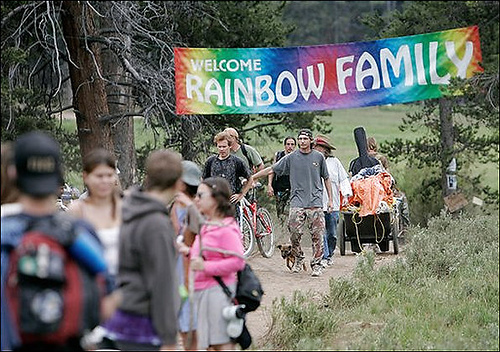
News footage showing the gathering around a roaring fire when there is a burning ban in effect doesn’t arouse a great deal of sympathy, and the media don’t o much to paint a positive picture of those traveling to join the host. There are legitimate concerns about the park resources being overwhelmed and about some of the folks being insanely unprepared for conditions at the northern end of Vancouver Island. The sad fact is that there aren’t likely a lot of communities hereabouts that would offer an alternative without some up-front money for services and damage deposits, funds unlikely to be forthcoming from the Rainbow Family. I guess, since this gathering won’t inject millions of dollars into the local economy, that most communities would rather they just not hold the gathering at all, even in the case where people might approve of some of the RF outlook. So BC Parks Service has closed Raft Cove Provincial Park and will station personnel on site to ward off any new arrivals. Cited as reasons for the closure were concerns about public safety, specifically that of the campers who seemed ill-prepared for the hardships they would face. There were also worries about damage to a sensitive local environment.

However, it might seem somewhat hypocritical of the authorities in light of what is a major part of the activity that sustains communities all up and down Vancouver Island, and the manner in which that business gets conducted (see below).


CC

Speaking of Burning

_IREMEN


There have been a lot of letters to the editor of the local papers about the cost of firefighters’ salaries, with some going so far as to suggest that this is one of the items on the city budget that is likely to lead us to a Detroit-style bankruptcy. The final straw was an op-ed in the Globe and Mail wherein Margaret Wente bemoaned the trend to becoming a nation of $100k firefighters, part of her argument centering on how cushy a job it is hanging around the firehall, doing 24-hour shifts where nothing happens and then going off to work another job so as to further feather the nest. I think she mentioned Owen Sound as a community that was bending under the pressure of salaries paid to these ne’er-do-well layabouts. I suspect that a certain amount of the local outrage is focused on anyone who has a better job than the complainer, or someone who feels that his property taxes just don’t represent good value for money. However, the jealousy and pettiness that underlines many of the complaints belies the worth of the work done by firefighters when called upon to get dirty, to get hot, to face fatigue and danger while working to save life and goods in situations where ordinary citizens are neither trained nor equipped to do the job. There is a certain amount of background noise, mostly emanating from some regional jurisdictions, but mostly from the provincial government, about the monetary value of work done by public servants in general, this coming from people, mostly politicians, who benefit hugely from the public purse, and who sit in the legislature for a miniscule portion of the year. I find it particularly appalling that citizens would call for the conversion of full-time fire fighting jobs to volunteer positions, implying that these folks should do the work for no pay. I would propose, rather, that those who perform volunteer firefighting duties be converted to at least part-time salaries, or perhaps some fee-for-call-out scheme. This should apply to all first-responders, ambulance drivers, first-aid attendants, auxiliary police, or anyone else who performs a valuable service for the community. Where do we get the money? Start taxing capital at the same rate as labour: with trillions stashed in offshore havens, there is a large pool of capital cannibalizing the work that people do without creating real value or building an economy where people willing to work can make a decent living.

firetruck


(Photos are from the PAFD site)