This morning’s Globe and Mail talked some about the possibility that the merger between Bayer and Monsanto might result in the disappearance of the Monsanto name, and quite possibly the baggage that accompanies that name.
Said baggage consists of a history of developing technologies aimed at controlling the seed supply through patents and ownership of gene modifications that have been spread through the food production and distribution systems through heavy doses of lobbying, distraction, bullying and stealth, a litany of sins that doesn’t seem to have developed the least shame on the part of the perpetrators. Among those working for a more equitable and sustainable future, the name Monsanto is emblematic with pretty much all the sins of our current legislative, judicial and regulatory régimes.
The name might disappear, but I doubt, and hope, that the awareness of the deeds will simply be transferred to the new parent company, Bayer, short of a radical turnabout in company policy. This turnabout seems like an unlikely happenstance, given Bayer’s already clouded name over both pharmaceutical marketing and development, and their long record of standing by neonicotinoid pesticides that seem clearly implicated in bee die-offs.
A shift to people-driven small-holding organic and permaculture processes in food production is advocated in a growing number of quarters as a tool in reintroducing a healthy diet and in controlling runaway climate disruption. This is antithetical to Big Ag, but represents the nature of the shifts that need to take place if we are to continue to inhabit this planet.
May we all stay aware and not be distracted by a corporate machination and a change of name while the underlying misdeeds continue.
I read this piece from The Disaffected Lib, alias the Mound of Sound, one of the most thoughtful and trenchant of the blogging crew. It’s frightening mostly because it tells a truth that many of us seem to want to duck and delay. Then our Premier unveils a new climate plan that is, in effect, nothing but a stalling tactic to allow the friends of the current government to finish the final pillaging of the public weal. Knowing, and seeing daily, the degradation of the living space that is our planet, and knowing, and seeing daily, the willingness of those supposedly in positions of leadership to completely sidestep the crucial service that they owe to their electors, to future generations, and to all life forms on Earth is a jarring experience. Yes, Christy Clark is showing true leadership, but not of any sort worthy of admiration and emulation: she demonstrates perfectly what is necessary to embody the foot-atomping, fast-talking irresponsible truth-twisting and selfishness that will be the death of many in the short term, and of all of us in the longer term. Admittedly, she can’t accomplish this feat all on her own, but she is being ably abetted by our own Prime Minister of Canada, a suicidally compliant press corps and a business establishment that appears bent on dying young and leaving a big bank account (as a substitute for a beautiful corpse).
A couple of interesting reads at Common Dreams and DeSmog Canada stirred up the meninges this morning. The first outlines a choice that confronts shareholders at meetings of Exxon-Mobile and Chevron this coming Wednesday with regard to fossil fuels and climate disruption, the second outlines the somewhat disturbing message from Brad Wall’s recent Throne Speech in Saskatchewan as he undertakes another majority mandate.
It is sad that, following the application of major scientific resources to the question, including those of governments and fossil fuel companies, there are still legislators who can characterize climate change as “some misguided dogma that has no basis in reality.” The oil giants’ own documentation aligns closely with the reports of the IPCC, and given that these are the people who own so many governments, including, it would seem, that of Saskatchewan, Alberta and B.C., who, even with the introduction of a possible carbon tax in Alberta, continue to push for the construction of major fossil fuel infrastructure, meaning that they intend to get the stuff out of the ground and sell it off as quickly as they can (or as their proponents in private business can).
The fossil fuel industry continues to justify its existence on the basis of the economic activity it generates without mentioning that, for all the dollars it has spent on financing sales of trucks, RVs, ATVs, McMansions, and extended holidays in remote and romantic locations, it has taken out more than it has left. Despite the bleatings about the heavy burden of taxation imposed on fossil fuels, the corporations involved, as well as their executive suites, have made out like bandits, and the least subscribed beneficiary has been the public weal as a succession of federal and provincial régimes has deferred taxes and subsidized both directly and indirectly, those corporations who make such large withdrawals from the common resource. This doesn’t count the costs of remediation of the devastated landscapes of the Athabaska region, oil installations in Saskatchewan, Northeast B.C., along with coal mines hither and thither across the Canadian landscape and the potential for offshore spills in Atlantic Canada. The only reason this economic activity hasn’t been replaced with reconstruction and refinement of public infrastructure and the transition to sustainable energy is the set of close links between business and our various governments, leaving said governments to protect the privileged economic and social position of Bay Street and its equivalents in Montreal, Vancouver, Calgary and elsewhere. It has become abundantly clear that those in the executive suite have known for decades how harmful their activities are and have pursued those activities in spite of the message that they are literally destroying the common living space in a headlong rush to amass wealth before the whole show goes up in smoke. They have essentially taken out a mortgage on the future of humanity (and much of the rest of life on Earth) without having the least hope of paying it back.
The rest of us bear much of the responsibility for allowing this to happen. Just as the rise of idiot candidates for high office in many jurisdictions shows a lack of education and the fortitude to call out the insanity that fuels the inane behaviour of the political and mercantile classes, we, as a society, have in large part drunk the Kool-Ade, taken out loans even when we know that we likely won’t be able to pay them back, accumulated material wealth and the trappings of wealth without consideration for the consequences. Perhaps we can excuse ourselves with the idea that everyone around us is doing it: it’s difficult to live frugally in a society that prides itself on freewheeling because there’s always more where that came from, where the cultural norms are modelled around a high level of consumption. Like Cassandra in Greek mythology, telling unpleasant truths brings either disbelief or an unwillingness to act on the consequences of our actions. Repeated warnings about the dire consequences of our inaction on our climate (along with social and economic inequality, water shortages, myriad sources of pollution, toxic diet, nuclear weapons, epidemic outbreaks, genetic roulette, and the headlong rush into technologies whose outcomes are utterly unknown) have met by ordinary citizens (taxpayers, consumers, and the like) with the same contempt, deflection and denial that comes from our elected and mercantile representatives, as well as a sizeable portion of our spiritual advisers.
Over the last four or five decades, we have built an economic system that is willing to pretend that growth can continue uninterrupted ad infinitum and that money can create money. This is particularly evident in the need for people to save money to buffer their economic well-being through times of uncertainty and to ensure that there will be some sort of retirement available when work is no longer feasible for desirable. Both savings and pensions rely on investment, especially where the generation of serious gains is most achievable. The result is that many pension funds and investment vehicles are loaded up with, you guessed it, fossil fuel stocks, as well as arms manufacturers, tobacco, pharmaceuticals and investments in the financial institutions that promote overconsumption, excessive borrowing, occult financial dealings and tax avoidance, and the suborning of the electoral process. The idea that someone might act in the interest of society as a whole is a quaint anachronism, it appears, while it is accepted that doing anything for profit is the new norm, even if that profit derives from cost analysis that excludes “externalities”, including the possibility that the downstream effects of the activity in question might be deleterious to multitudes and span decades. Our work at reprogramming the Universe holds grave risks where it might better suit our purposes to sit back and contemplate the ramifications before charging ahead with all the genetics and AI that might have disastrous results for life on the planet. The outlook is pretty bleak for those who take the time to connect the dots, and a lot of the bleakness stems from the willful ignorance of those who have taken the whole of humanity down the path toward an early exit from the rolls of the living.
(Don’t remember if I’ve used this before, but it seems apocalyptically appropriate)
Aerial view of Syncrude Aurora tar sands mine in the Boreal forest north of Fort McMurray.
Ok, so I just donated money to the Red Cross to help out victims of the current wild fires in and around Fort McMurray, but I do so with large reservations. First, there are parts of the Red Cross that have a track record for behaving badly with donated money, and I have a general distrust of large charities, given the level of funds that get plowed back into fund raising and administration, executive salaries being one of the most egregious fouls. I also find it difficult to conceive that our society is built upon such weak links that we have to appeal to people’s empathy to get us to pony up for emergency backstops when this should be a proud function of the common polity through our agent, the government. Sadly, we have too many governments that act as captured read pools for the privileged and who blithely spend money on destruction, administrative waste and subsidies to their sponsors, who even then manage to cook up little schemes such as those highlighted by the KPMG affair and the recent release of the Panama Papers to salt away large swaths of unearned wealth where the common polity can’t touch it and where it can do no good for the general citizenry, as would be the case where we had adequate (or better) resources to fight fires, and to ensure the safety of all those affected by disasters of this, or any, nature.
There is also some (guilty) delicious irony in the location and circumstances of these fires, though, particularly in the face of scientific probity and the more flagrant roadblock of denialism, to actually draw a causal link between the carbon generated by the mining of the Athabaskan Tar Sands and the record hot and dry weather currently contributing to the propagation of hellish levels of forest fire activity. It’s hard to fault those residents of Fort Mac who are the victims of the burn: who turns down the kind of remuneration that oil patchers have been making for the last however many years? But where is the reinvestment resulting from the wealth generated in Canada’s short stint and an Energy Superpower? Not in Canada, mostly, having been shipped out to Shanghai and Houston (Texas, not BC).
As usual, the people in question, in this case the residents of Fort Mac, along with the competent authorities, seem to have made a good job of getting all and sundry out of the place alive, and generally in good health and spirits, if we’re to believe reports in the media (another question entirely, and what else are they hiding under cover of the fire stories?). This speaks to preparation, calm, competence and cooperation, often the operating mode in disasters, per Rebecca Solnit’s A Paradise Built In Hell. The conversation about mutual aid needs to be part of our everyday discourse, particularly when we consider how vulnerable we are to all manner of cataclysms, and any safety net structures we can put in place, along with the attitude adjustment that should accompany that building, will likely stand us in terribly good stead as we get further into a destabilized climate and into the destabilized society that has been occasioned by the plundering of the greedy over, in particular, the last forty years.
(I may have used this before, due to its Karmic implications. Sorry.)
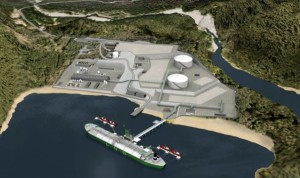
A little item on the news this morning, that Catherine McKenna has green-lighted the Woodfibre LNG plant, with a note at the end of the item that a contract for the engineering had been let to Houston-based KBR.
Sound familiar? It should, since KBR is associated with Halliburton, hence inextricably linked with the shenanigans of one Dick Cheney, who had a few energy-oriented adventures in Iraq not so long ago. KBR was also a supply and infrastructure contractor for U.S. forces in Iraq, doing work that would, in times past, have been done by the grunts, but, hey, the grunts can just fight and KBR can do all the background work for a not-so-small premium.
Never mind that McKenna’s approval sets in motion a process that essentially negates her whole mandate and Minister of the Environment and Climate Change (at least in the way that I thought she would be attending to climate change), wherein she will not only blow through any promises made at the Paris climate talks, but also, given the fracking process to extract the NG, because she will become one of the proximate causes of the trashing of the environment in large swaths of rural Canada, particularly in BC.
It’s a rather ironic picture of Real Change and those who voted Liberal should be experiencing extreme cases of buyers’ remorse.
In Libération this morning, a little item that the French government is readying a law that would decouple the link between polluters and players when it came to assessing penalties for environmental damage. Our provincial government may not have done this in legislation, but they have surely accomplished the same end without bother of recourse to the law, given what has transpired in the wake of the Mt. Polley tailings dam breach and subsequent run-off. There are many other instances where the law is twisted, flouted or simply ignored, and it wouldn’t surprise in the least to have the CC gang simply change the law in their favour. They seem to have captured the courts, a group where certain strata of the judicial corps seem not to have heard of SC decisions regarding treaty rights. But, what the hell, with CETA and the TPP, the law is pretty meaningless in any case, sort of a glass case through which citizens can witness the destruction of civil society as it is dismantled by secret tribunals in another room, behind the curtain,
For those whose French is a work in progress, the headline, from Libération, states that unfulfilled promises of reform kill the very idea of democracy. Of course, this is very true of the current administration of President François Hollande, as it is of Jean-Marc Ayrault and Emmanuel Valls, his two Prime Ministers, but it seems a recurring theme with governments both in Canada and abroad, and very much on point with current discussions of the signing of the Trans Pacific Partnership, where the meaning of the campaign slogan “Real Change” is shown for the hollow rhetoric that it is. Minister Freeland would have us believe that signing is not ratifying, but with a whipped majority and an ignorant electorate, ratification looks like a reasonably sure thing, showing to what extent the Liberal Party of Canada is in thrall to the same interests, if not exactly the same players, as the previous Conservative administration. Trudeau is looking increasingly like More Of Same rather than Real Change, in much the same fashion as the Hope and Change of 2008 morphed into Wall Street ever present in D.C., Guantanamo still open, another market bubble, increased wars and more carbon than ever pumping into the atmosphere. Is it any wonder why people seem reluctant to spend whatever minimal time it takes to get to the polls? It isn’t as though North America has a corner on the broken promises, given that the hope for a better future engendered by the formation of the EEC and then the EU has turned into a huge bureaucratic boondoggle and an entirely captured enterprise in the neoliberal mode. The rising tide of economic activity in Asia has failed miserably at making a decent life for most Asians, and Russia, post-USSR is a basket case with economic disparity on a level rivalling the Russia of the Tsars. The phenomenon occurs at all levels, not being restricted to national governments, as can be seen here in BC where our current administration wants to pull both triggers of the climate shotgun by giving pride of place to dilbit pipelines and LNG development, having first created conditions to ensure that none of the possible benefits stay here in BC.
Is democracy sacred? We look to find out fairly quickly whether its replacement will do better and creating conditions for inclusive well-being, a state that should be sacred.
“The illusion of freedom will continue as long as it’s profitable to continue the illusion. At the point where the illusion becomes too expensive to maintain, they will just take down the scenery, they will pull back the curtains, they will move the tables and chairs out of the way and you will see the brick wall at the back of the theater.”
― Frank Zappa
One report was published by the Fraser Institute, the other by the Wait Times Alliance, and both outlined a rather dire situation for people awaiting referral to a medical specialist for treatment, delays that haven’t lessened despite injections of cash from whatever level of government. Global News aired the first report and followed up with a personal account in an on-line piece posted here (video also available).
The sum of the two reports is that we’re trying to achieve different results by applying the same processes and thinking, a mode almost universally acknowledged to produce little other than frustration. The underlying message, the same delivered several times in word and deed by Dr. Brian Day, is that we should carve out a rôle for the private practice of medicine in order to reduce wait times.
Certainly wait times might shrink for those who could afford to jump to the private side of the medical equation, but it would certainly torpedo any notion of universality and would, above all, line the pockets of some physicians and the investors who would expect to reap a benefit from the work of some and the misery of others. Piling on another ten per cent for investor profit seems a strange way to get out of the cash crunch unless the intent is to eliminate access for some clients while expediting the draining of the bank accounts of others.
There is an interesting benchmark that the two studies seem to have set for purposes of comparison: the baseline year being 1993. For those with short memories, this is the period immediately preceding Paul Martin’s book-balancing feats, accomplished largely at the expense of transfer payments, and specifically the unravelling of the universal health care system. My mother had a hip replacement in 1994 and my father had bypass surgery the same year. I don’t think either of them had time to get a referral before the surgeries were done to remedy the condition; in neither case did even a week lapse before the intervention took place.
These two reports smack of yet another stab at introducing the same chaotic and dysfunctional system of medical delivery that we see in the U.S., and what the reports scream at high intensity is that greed is the primary motivator of both these organizations.
Pic is really from Dico Larousse and should be titled, I think, Je sème à tout vent.
The full title expression is:
Qui sème le vent récolte la tempête.
Check out France’s military and commercial interventions and it’s easy to see why Paris would be a target. The violence on both sides speaks to a failure of understanding, dialogue and diplomacy. Condemnation all around for said violence. Could last evenings events be part of the tempest of the above expression?
Also worth noting, perhaps, is the ongoing and increasingly pronounced inequality of opportunity and income that grips French society along with the rest for the Western World, and the World in general. The election of a Socialist government in 2012 has meant an extension of the same policies inflicted on the country by the neo-con/lib Sarkozy. Mitterrand taught us the same lesson. The impoverished tenement districts of many French cities are cesspits of crime, insecurity and despair, and fertile territory for the radicalization of young folks who see no future for them in society as it is presently structured.
Strange that Erica shared with me an article from Canadian Mennonite the other evening about a pastor noting that the sugar he put in his coffee in Hawaii had likely been grown a stone’s throw from where he sat, but that it had been shipped to the US mainland, processed, packaged and shipped back. He figured the little sugar packet had travelled some 16 000 kilometres before being dissolved into his coffee and returned through biological processing to its native soil. Wait, there is a link: this reminded me of the passage in Candide (Voltaire, 1759) about a runaway slave from a sugar plantation in the Caribbean area who was missing various parts of his anatomy because he tried to escape his servitude, and each time he did so, his master would remove a hand or a foot.
On nous donne un caleçon de toile pour tout vêtement deux fois l’année. Quand nous travaillons aux sucreries, et que la meule nous attrape le doigt, on nous coupe la main ; quand nous voulons nous enfuir, on nous coupe la jambe : je me suis trouvé dans les deux cas. C’est à ce prix que vous mangez du sucre en Europe.
…some get the sugar, some pay the price.
The Islamic State is a nasty bit of business, and it’s an easy decision to deplore the violence they have visited on Paris, as well as a litany of barbaric acts committed all over the Near East and beyond. But did no one take a moment to get François Hollande to reflect on the causes and effects of his adventures at home and abroad? When he ambles through the aisles at FNAC or Galéries Lafayette, does he never consider the notion of “You broke it, you bought it.”?
We live in a society exquisitely dependent on science and technology, in which hardly anyone knows anything about science and technology.
—Carl Sagan
The above citation speaks eloquently to the closing of libraries and the restriction of scientists’ contributions to ensuring that we have a livable planet and some creature comforts (like food, a sufficiently oxygenated atmosphere, quality drinking water, shelter, clothing, communications and all the other stuff on which society is based). It speaks to the claptrap that issues forth from legions of self-serving and greedy community “leaders” who want to continue blithely on with business as (what they deem to be) usual because it protects their position of privilege. It speaks to a wilful ignorance that allows for misdirection and malfeasance in governance at the corporate, local, municipal, state/province, national and international levels and to the trashing of the notion of an informed citizenry, a population not transfixed by the shenanigans of the beautiful people and the stunt men, by cat videos or by the next fix.
Those few who can and do invent, produce, deploy and maintain the systems on which we depend might end up forming a sort of high priesthood of Wizard-Of-Oz-like directors on whom we will all be blindly dependent. This reign might also be short-lived as the ignorant masses simply overwhelm the literate and send civilization to a tawdry end. The prospect is frustrating because of the unnecessary nature of the process and the loss of what could be a decent life for all.
Don’t argue with idiots: they’ll drag you down to their level and beat you with experience.