So all people can now get married and enjoy the responsibilities and benefits that our society accords to people who settle into a domestic union. Like interracial couples, LGBTQ folk should now have access to what the rest of us have enjoyed in terms of societal recognition. community acceptance and tangible benefits over the span of recent history.
So here is Nancy Pelosi, House Minority Leader, celebrating Pride and the Supreme Court Ruling that says that people ought not suffer discrimination based on sexual orientation.
Problem is that a raft of Democrats then climbed on board the TPP Fast Track wagon, expediting the adoption of yet another treaty that has less to do with real trade than it does with ensuring corporate rights to make profits before all other considerations, including human health, the environment, and the democratically expressed will of the people of the U.S. Lest we feel smug, we need to remember that Canada wasn’t originally scheduled to be included in the TPP, but Stephen Harper whined and complained loudly and long enough that the rest of the guys gave up and allowed him into the club. Negotiations have been held in the most strict of secrecy and only small parts of the treaty have leaked out, but we can say with a degree of certainty that the section on investor-state relations, the Chapter 11 of this monster, is the key and basically enables malcontents in the corporate world to sue the rest of us for profits they think they might have accrued had laws not been passed to insert sticks into their spokes. I believe it also allows the suits to override whatever restraints any jurisdiction within the signatory countries might put on unbridled greed.Note that these cases are heard by (again) secret trade tribunals set up by the corporations themselves.
In effect, your vote doesn’t really mean anything any longer, unless you and any democratic pals you have can fly under the corporate radar. I don’t quite know how that could happen with the increased surveillance that seems to happen all over both the corporate and government sectors, sectors which seem to be closer to a complete merger with each passing bit of legislation.
So to all the LGBTQ folk, welcome to equality, but you’ve picked a bad time to win this equality, because it means that you will basically earn the same exploitation as the rest of us.
(In all fairness to Ms. Pelosi, I believe she voted against Fast Track in the House, but her friend Diane Feinstein voted for it in the Senate, so it seems that there is unlikely to be any public debate on this corrosive corporate dreck.)
We went to an actual movie theatre last night to see Inside Out, my first go-around at a 3-D movie and a bit of an adventure, given my rather sour attitude toward Disney, with or without Pixar. The film didn’t disappoint: it was full of emotional moments pulling all the familiar levers to generate empathy/sympathy and stunning animation to go with the sassy, cliché-laden language of contemporary pre-teen parlance. Still, I was there because my grand daughter, a somewhat atypical eleven-year-old, had told me that I should see this film, and she was present, along with Mummy, Daddy, Baby Brother, Friend, Nana, Grandpa and Grandma. I could see where she would like the film and where it might raise some interesting questions were they laid out in some sort of reflective way.
The feature was delayed because some folks had arrived too late to get through the gauntlet of ticket wicket and concession. I hate it when people aren’t punctual, and even more when others cater to the needs of the tardy. Hence, I was not in a particularly receptive frame of mind when I was shown a trailer for the upcoming screen adaptation of St.-Ex’s Little Prince.
It’s a lovely little tome that Grand Daughter recognized right away as being a part of Grandpa’s cultural firmament, a book that reads well as a child’s bedtime story or as an adult reflection on a plethora of knotty problems confronting those serious and sensitive enough to question their way of life, their relations with other people, animals and things, and the way perception can affect reality. The language is simple without being simplistic, and the illustrations, done by St.-Ex himself, are charming accompaniments to the text.
The trailer tells me right away that I won’t be going to see this film. It layers another story over the original princely narrative, nesting the Prince in a contemporary context of a controlling family, reiterating one of the central themes of the book in a most unsubtle and decontextualizing way, keying into that same sassy cliché of pre-teen angst that flavours so much of the Disnified reality superimposed on so much of the life lived by young folks in the current context. I don’t want to have to fight through the Disney layer (is it a Disney film? It hardly matters.) to get to the charm, and likely, for the price of admission, I can buy a copy of the book and read it to my grandchildren, or to myself, for that matter.
I was silly enough to read a couple of books by a man named Pierre Boule, Planet of the Apes, and Bridge On The River Kwai. If ever screen adaptations messed up the message of original novels, Boule got messed over royally. I fear that St.-Exupéry is about to get a somewhat milder dose of the same treatment. It’s sad that we can’t come up with original narratives that better reflect what film makers want to say without twisting someone else’s work into something it was never intended to be. Dr.Seuss is another recent victim of this kind of Hollywood trivialization, and it seems that Charles M. Schulz’s estate is offering up some of the same for next fall.
Worth knowing that St.-Ex’s other works are for adults and are well worth reading for their reflections on adventures, confronting danger, the agony of defeat. His own story is worth a look.
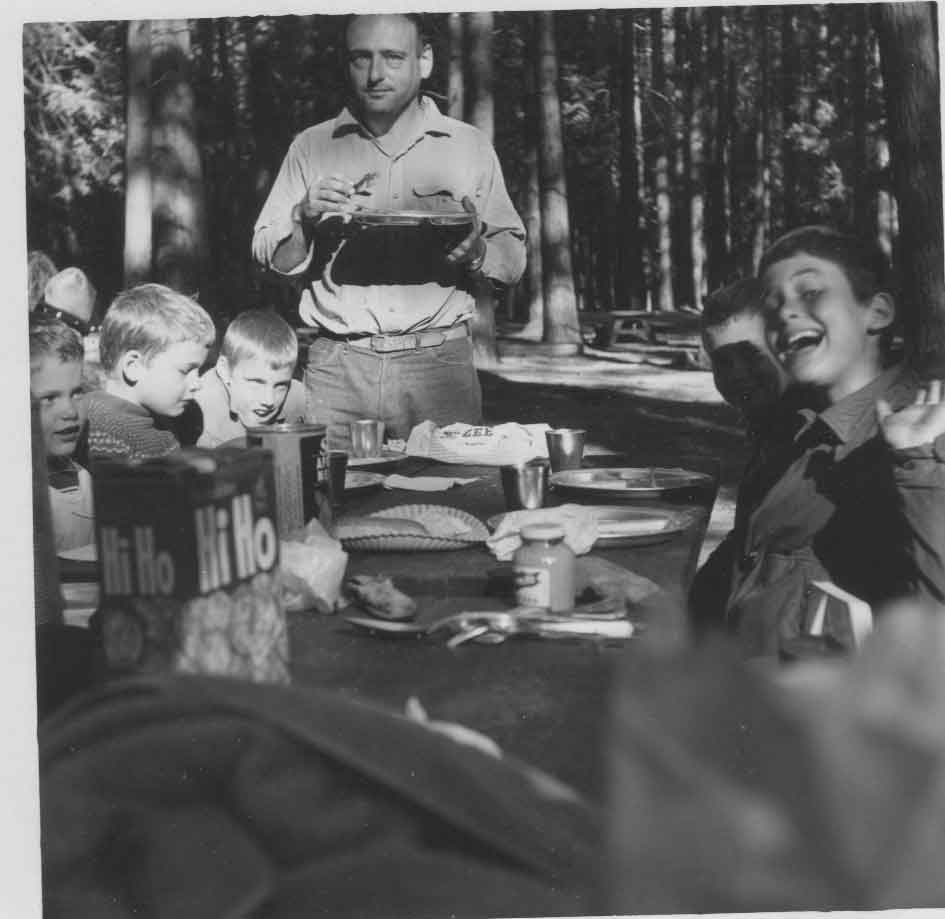
And there is almost the whole rotten hockey-sock full of us, camping at Mt. Lassen in 1958. Maggie is off somewhere tending to the latest, baby Gabrielle. I got on well with my Dad, though I occasionally got into a tempestuous funk when he called bullshit on some of my out of bounds forays. Retrospect, even the shortest and most immediate, drove me to apologize and acknowledge that he was likely right about everything he said, and ultimately, it was that schooling that helped me to be a reasonably constructive being (of course, I also had the benefit of a mother who tempered whatever hard-nosedness I perceived on Dad’s part, so equal participation in whatever good I might have done).
This all came to mind when the house filled up with the perfume of black currants last evening, part of the cycle of things ripening in the yard and coming indoors to be eaten or to be processed for later reference. Black currants make wonderful syrup (Crème de Cassis) or jam/jelly. Dijon is famous for its currants, as is another spot somewhat to the North and West, Bar-le-Duc, which was the source for a blackcurrant jelly that Dad particularly liked.
So, after enjoying the perfume of the blossoms, I watched as Erica pulled the fruit off the bushes while I did some grunt work close by.
Then they went into the steam juicer and into the Maslan Pan.
Eventually, they look like this. There was even a partial jar so that we could toast some of Erica’s whole-wheat bread and slather it with our own home made jelly.
I have no children of my own, but I worked at being a decent mentor for my stepson and have been pretty present in the lives of his kids. The young man in question asked me long ago why I never seemed to get upset and I explained to him that first of all, I had two grandfathers who didn’t really want to deal with children and whose gruff manner was enough to ensure that there would be no attempts at intimacy, and that, as well, he never seemed to do anything worthy of anger (true statement).
When he was over on Thursday, we snacked and cobbled together a home-made periscope, something that arose in a book his mother had given him.
The book also had material on spiders, on bruises and cuts, on sea urchins and a wealth of other topics. most of which the little man wanted to share. His mother’s parents live in town as well, so he and his sister are surrounded by care, love and coaching at many levels.
As much as to say that life in our little circle is pretty darn wonderful. The sad part is how quickly the picture degrades as we move away from that centre of friends and family, a wider world that seems to have forgotten the value of integrity, truthfulness, mutual aid and caring.
It is somewhat comforting to think that there are myriad other little islets of family and friends, of integrity, truthfulness and caring, though the network is spotty and we aren’t all connected, and that there might be a possibility that cooperation, collaboration and mutual aid might emerge as a dominant way of directing our actions. The alternative is too ugly to contemplate.
The Globe and Mail has a post about the seven books that Bill Gates wants me to read this summer and he’s qualified to direct my education because he’s…rich? Because he made a ton of money selling half-baked and shoddy software? Because he aided and abetted in the dumbing down and distraction of his fellow citizens? Because he cloaks his current sleaze behind a curtain of show-philanthropy?
Better we all develop healthy bullshit filters and go read the blogs for an hour or so a day, then look for works that will theorize on how to get us out of the hole rather than digging it deeper, then find good works of literature, some of it foreign (broadens the perspective) so you can die educated (I guess it might help to influence a few other folks, who knows?).
Ignore Gates and read the Globe and Mail only as a penance.
I signed a petition today in what will likely be a vain effort to forestall the construction in a prominent location in Ottawa of a monument to the victims of communism. Even though that brief interval and the energy of a few keystrokes may have been wasted, it is a fine jumping-off point for some reflection on ideology and the ideological underpinnings of régimes and their resulting misdeeds.
The motivation behind the monument, along with the scale and placement of the structure amounts to a dishonest pandering to one or more constituencies being curried for votes and financial consideration and perhaps to a lasting sign of the Harper legacy of eschewing any real diplomacy for supporting the side that best suits his own ideological and religious bent. Ideologies, like guns, don’t kill people, but, also like gun, if you leave one lying around, there’s a pretty good chance that someone will pick it up and use it for his own ends, likely in the service of coercion. In this, communism has certainly been the backdrop for millions of victims, but let’s not mistake what we called the Communist Bloc for communism: the USSR and its satellites were tyrannic dictatorships that spouted communist rhetoric as they exacted vengeful exactions indiscriminately on their own people and on those who had the great misfortune to fall under the extended Soviet influence. Do other ideologies have a tally on the victim slate? I would think so, even in something so “innocent” as the British/American strategy during the Second World War of delaying direct engagement with Axis forces in Europe until the Russians (note: Russians, communists and otherwise) had essentially absorbed the worst punishment that the Third Reich could hand out and turned the tide against the Nazi menace. Under the occupation, sympathetic factions arose in almost all countries to carry out many of the worst atrocities attributed to the Nazis, using National Socialism as a screen behind which to shelter the murdering, rapine and thievery that was at the heart of the matter, without regard to some ideological justification. And when the tide went the other way, there was more of the same, but from the other side, and pretty much without regard to any opposing or replacement ideology. The story of Alexander Solzhenitsyn is instructive, a seemingly loyal artillery officer who, at then end of the Great War, was gifted a dozen years in the gulags, demonstrating that Stalin et al were equal opportunity oppressors.
On the other hand there is the purported antithesis of communism, capitalism, whose record contains a litany of the same horrors perpetrated by the Stalinists. In theory, it is a perversion of capitalism for personal gain that lies at the root of the crimes, and that puts capitalism in exactly the same category as communism. It’s interesting to note that Mussolini characterized fascism as the marriage of capitalism and state power. This sounds vaguely familiar:
Let’s add Pan-Slavism and Zionism, the Greater Asiatic Co-Operation Sphere, The White Man’s Burden, the Greek, Roman, Egyptian, Aztec and Incan empires to the list of ideas that have wrought great deeds (their own definition) and left great works as monuments to their superiority (yikes, do the world’s great religions get caught up in the net?). So really, to be fair (not something for which the Harperites are really known), each of these ideas should have a memorial erected to the memory of its victims, and, given that real estate in Ottawa is at a bit of a premium, we could do these memorials as scale models of the great works such as that planned for the victims of communism, and house them all in a single building.We could then call it The Museum of Civilization.
This is a revolutionary act, telling the money to walk because it maters not where the environment and culture are concerned. Too bad it took the rest of us so long to figure out that those First Nations we beat up so badly might have had the right idea in the first place and that Wal-Mart doesn’t wash when the devastation hits.
How ironic, the Clarkish one in the rôle of teacher. Ms. Clark has come up with another doozy in the wake of the Notley election in Alberta, to the effect that she has a lot to teach Alberta about carbon and climate change, and that, in fact, she has much to teach the rest of the country. Presumably this is because we have a carbon tax and they don’t, but she fails to mention that the carbon tax was a ploy by her predecessor to hog tie Carole James, making her either agree with the rampaging Liberals, or gainsay them in a move that would alienate her from voters in the greener shades of the spectrum, politics pure and simple. Herself hasn’t helped to redefine BC as anything other than a carbon furnace with the continued shenanigans related to the Pacific Carbon Trust, to dedicating agricultural land to carbon offset projects, and mostly her giveaway support of the gas industry, particularly the fracking end of it.. Her government has consistently missed opportunities to support alternative energy, despite indications that wind, solar, tidal and geothermal energy all hold great promise. She is an object lesson in what not to do, even as she waggles her finger at the rest of the country from the standpoint of someone who, without any reasonable explanation, seems to consistently dodge the consequences of both her actions and her inactions.
“One of the world’s greatest problems is the impossibilty of any person searching for the truth on any subject when they believe they already have it.”
—Dave Wilbur
James Lunney: Christianity under siege
James Lunney, National Post Monday, Apr. 13, 2015
The past year has seen unprecedented attempts to diminish, discredit and suppress a Christian world-view in law, medicine and academia. That was the message from Christian leaders a few weeks ago in Ottawa. At the same time three politicians, all Christians, were publicly condemned as ignorant and unscientific for daring to disagree with an intolerant fundamentalist religion. Questioning theory vs. fact is the unpardonable sin for adherents of evolutionism.
Bigotry and intolerance are the trademark of militant atheism and its adherents’ campaign against God. Conrad Black exposed as much in his eloquently written and defended articles recently. As a multi-racial, multicultural, multi-faith society, Canada has been known to a world in conflict as a standard for respect for diversity and inclusion. However, a religious defence of science seems to be the vehicle for the most vitriolic, pejorative, vulgar campaigns of intolerance and ad hominem attacks in Canada today.
These public shaming assaults are not in keeping with the nature of scientific inquiry or the character of an otherwise extraordinarily tolerant nation. They are the hallmark of scientism and evolutionism bearing all the hallmarks of religion, but unrestrained by any modicum of respect for anyone who contradicts the tenets of the faith. In this regard militant atheism is more akin to militant Islam than any of Canada’s multi-faith communities.
Evolutionism is losing its grip as biological sciences have outstripped any rational defence of the origins of life or the complexities of the simplest cell ever coming into being by random undirected events or natural processes. Darwin was a brilliant naturalist; his keen observations have inspired great advance in our understanding of how living things are related. However the world of the cell was beyond anything Darwin could have imagined.
The notion that belief in God is incompatible with pursuit of science is a falsehood clung to by a dwindling cadre of atheists in the science community today. It began with Darwin’s cousin, Francis Galton, a brilliant scientist in his own right; and the father of eugenics. While Gregor Mendel, was laying the foundation for modern genetics, Galton was promoting the concept that belief in God was an impediment to the advance of science.
The concept of Non-Overlapping Magesteria is a sanitized repackaging of Galton’s legacy adopted by the American Academy of Sciences. While atheists have made great contributions to science, the identification of the DNA molecule by Watson and Crick does not diminish the contribution of Francis Collins, an evangelical Christian who led the effort to decode the three billion base pair sequence of human DNA. Collins wrote in The Language of God: “DNA is the most efficient information storage system known to man!”
Science is agnostic. There is room for people of all faiths or no faith to contribute to science; indeed that is the historic record.
It was the NDP who shut down my attempt to put this on the record in the House of Commons. Ian Capstick, former NDP strategist and communications director, stated on national TV that he had to “take me down.” He describes himself as a militant atheist. Rick Nicholls was savaged in the Ontario legislature, while Gordon Dirks was targeted in Alberta, but not because either is a threat to science. Rather, they failed to affirm evolutionism, the religion of the militant atheist.
Capstick boldly states he is going after the charitable tax-exempt status of the church. Does he speak for Tom Mulcair? Who is funding the campaign to disparage a Christian worldview and pressure the Canada Revenue Agency to strip churches of their charitable status? Is it the big banks and corporations that wrote to law societies trying to shut down the TWU law school?
Who are the 22 members of the Ontario College of Physicians and Surgeons who unilaterally moved to strike down doctors’ long-standing Charter rights to refuse to provide services that would violate their conscience? Dr. Chris Simpson, president of the CMA, says eliminating conscience provisions is not acceptable; but Ontario doctors, like Trinity Western University, are now compelled to launch costly Charter challenges to defend their rights.
Evolutionism is based on a false construct from another century; it is as repugnant as any other form of bigotry. If this campaign for a godless Canada were successful, the Canada that would emerge is one that few Canadians would recognize and most would not want to live in. The “shabby, shallow world of the militant atheist”; it couldn’t be better stated.
National Post
James Lunney is independent member of Parliament for Nanaimo-Alberni.
Martyrdom has always been a proof of the intensity, never of the correctness of a belief.
—Arthur Schnitzler
The right to be heard does not automatically include the right to be taken seriously.
—Hubert Humphrey
The following was published in the local paper as an editorial piece. David Black, the owner of Black Press, hence, the owner of the paper, is a proponent of pipelines to the Coast from the Athabaska Tar Sands and the installation of refineries on the Coast itself.
Diana West in The Death of the Grown Up challenges us to look accurately at the world around us and stop our delusional thinking.
She focuses on a number of interesting things including: a loss of parenting, nonjudgmental multiculturalism, and politically correct self-censorship as well as today’s victim, hero reversal.
But I want to talk about the biggest delusion of our day – the delusional idea that going green will benefit our lives.
Sure there are many sincere individuals who want to keep things clean, to be less wasteful and who wish to ensure that future generations can live a good life.
People with these beliefs are not a problem, they’ve only been mislead. This I call small green thinking. The earth doesn’t care if you pick something up and put it down in a different place.
No, it’s the strident activist, the BIG Green folk who are a problem.
These are the people that think there are too many people on the earth, that our factory system is environmentally destructive, that our energy use is killing the planet. In other words, that all our development is bad and needs to be stopped. I call them the Luddites of our era.
Truly, in a scant 300 years our lives are now 20 times richer than our ancestors. Mostly because some very bright individuals learned how to tame the energy embedded in fossil fuel. Because they shared their discoveries and inventions with their fellow man, the world changed – for the better.
We live in a man-made world.
Roofs keep us dry. Walls and windows and central heating keep us warm. Roads and cars and airplanes cause us to forget how our ancestors travelled. Our modern medicine system means we will die after 80 years of life rather than 30 as those ancestors did.
Today in the developed world, virtually everyone lives a better life than even the aristocracy of the past. As Milton Friedman said, “The ancient Greeks needed no running water; they had running slaves. Measured in human energy output, our energy use equates to some 90 people working for us. That is because we feed fuel into machines.
Today we have the equivalent of some 90 people working for us because we feed fuel into machines.
Everything that enriches our lives, and that we can afford, comes to us cheaply through the doors of a factory. The doors BIG Green wants to slam shut.
The destruction of enterprise begins if we fail to add ‘free.’
We would not expect good results if we put ignorant people in charge of brain surgery or rocket science….mechanics or construction, yet we have given the ‘right to impede’ to those who lack the ability to do or the desire to think about what they oppose.
BIG Green has lost its way.
These folks want to end the industrial world. They don’t look at the world from a human health consideration. Their view is distorted by what my friend Alex Epstein calls the ‘perfect planet premise,’ that a world untouched by man is paradise.
Well in truth, without man’s intervention, called ‘natural,’ life is more accurately described by Thomas Hobbes: “solitary, poor, nasty, brutish, and short.”
And it’s happening today.
Development is being opposed at every level in the name of saving the planet…from man rather than for man.
For proof we have the ranting of the BIG Green leaders. An interesting book, Merchants of Despair, by Robert Zubrin, provides a wealth of documentation. It’s your life…don’t let them steal it.
No carbon footprint means no life. Exploit the earth or die.
I suspect that Dr. Lunney and Mr. Seinen have both lived lives of reasonable ease and speak their truths for fear that anyone might impinge on their right to profit from the misery of others. Each is entitled, as are we all, to his own views, but it strikes me that neither should be allowed to intrude into the area of public policy. I would amend Mr. Seinen’s final statement to the following:
Exploit and die.
“The modern conservative is engaged in one of man’s oldest exercises in moral philosophy: that is the search for a superior moral justification for selfishness.”
A book, once it is printed and published, becomes individual. It is by its publication as decisively severed from its author as in parturition a child is cut off from its parent. The book “means” thereafter, perforce, — both grammatically and actually, — whatever meaning this or that reader gets out of it.
So works of art (books) are severed from the author, right, I understand that part, and that they become very much an “eye of the beholder” type of a phenomenon, but I;m not altogether convinced that the same applies to a child and its parents. While I’ve watched generations of children and young adults move toward a spiritual and intellectual, as well as economic “parturition”, I’ve been keenly aware of the continued influence of parents, partly through what seem like genetically determined behaviours (parent-teacher conferences often make this abundantly clear), but there are also clear influences governed more by social interactions in the family and, eventually in the circle of friends, a marriage, a working group and society in general. Interesting thought. A part of the book taking on a life of its own has often come up in literature classes where the instructor has the magic “right” interpretation and generally deems all else to be specious, thereby losing much respect and credibility among the offending and offended students: this is a realm where anyone can posit anything without the slightest need for documentation or justification. It could get lively in here…
From Facebook, a take on kids being kids, apparently from Tommy Chong:
Not a terribly exciting or engaging image, I have to admit, lifted, though, from this post on Libération yesterday morning in the course of the daily read-around. I’ve been engaged in the process of writing an Energy Descent Action Plan for out local Transitions initiative, a process that seems to drag on and in which few seem keen to participate, but one of the recurring themes is that we use too much of just about everything, and much of our usage is wasteful, literally, as we purchase and use goods that are built to fall apart or become obsolete and require replacement. I suspect that many of us have had the experience of having to replace a relatively recent major appliance because of the failure of an electronic module or because there are already no replacement parts available. Almost equally pernicious is the situation where an item can be repaired, but where the cost of doing so makes for little economic advantage over simply throwing it out and buying a new one. Hence the “excitement” over the above image, as it represents a washing machine labelled by its designer as “L’Increvable” , which is more or less meant to convey the idea of bullet-proof. His idea is that the machine should last a lifetime, that it should be user-serviceable (given a certain level of tool savvy), and that all parts be easily replaced and repairable. This way of doing things is a fair approximation of the opposite of the way most design and manufacturing is done, our current mode being predicated on an unlimited stream of materials and energy and a sucker population willing to accumulate large amounts of valuable material in landfills. Clearly, our current mode is suicidal as we move toward a world population of eight billion and as more and more of the world’s inhabitants are less and less willing to accept the deprivations of poverty to supply the consumer society in other parts of the world.
There rests the question of developing a species-wide awareness and ethos that will allow for a decent life for all. Can we dial back on our consumption so that others might have the wherewithal to live a life without want? Current indicators don’t hold out a lot of hope, particularly when the people in charge of the zoo seem set on a path of division and a desire to sequester as much of the available store of resources as possible for the use of a chosen few. It’s difficult to imagine the mass of humanity developing the mutual aid outlook as long as that mass is scrambling just to survive and facing interference and opposition form the people they should be helping and who should be returning the favour.
One of the best ways to reign in our over-consumption is to build durable, repairable and recyclable goods, and to encourage others to do the same. The insane chase after levels of material wealth that we’ve been sold is best illustrated in the tech sector where whatever gadget you buy is out of date about the time you finish the transaction to remove it from the store. New software requires the purchase of new hardware, and hardware seems to generate the need for software upgrades as tech companies bootstrap the upgrade ladder to waste and obsolescence. The same phenomenon appears in most phases of our existence, where single-serve coffee makers replace other methods of brewing that are perfectly adequate, but just aren’t the latest fad. This, of course, follows on the notion that we should have uninterrupted access to the beverage of our choice at all hours of the day and night, and we’re trained from an early age to expect this pampering because we deserve to have only the best. We just don’t stop to ask ourselves what that “best” is as we abandon civic duty and critical analysis in favour of accumulation.
Those of us who live in the lap of some version of North American luxury can celebrate the creation of a truly durable washing machine, but that celebration is also about having clothes to wash, an abode to house the machine, the clothes, and us, and clean water to do the washing, along with a host of other pre-conditions that don’t hold in many places in the world. Recently, my brother told me he had to replace the speed control on his stand mixer, and that he had to rig up a rheostat arrangement because there didn’t seem to be any parts of this particular machine. I had been through a similar vexation with a dishwasher three or four years ago, though that’s where the similarity ends. The dishwasher was less than three years old and no parts could fix it. It has become a dish drying rack for dishes we wash by hand and we seem to be none the worse for it. The stand mixer was purchased in 1950, and, with the installation of the rheostat, is now fully functional. Perhaps l’Increvable is a sign of a return to an outlook that will allow us a little breathing room in our quest to balance our lives in a way that will see future generations stretching our for centuries. Without that rebalancing, the prospects for life beyond a generation or two seem pretty discouraging. Too bad for us.
Living as if there were no tomorrow, we are converting a carefree metaphor into a self-fulfilling prophecy.
—John Whiting
One who knows “enough is enough” always has enough.