More Misdirection


Journo

This pic is from:
http://suttonhistoricalsociety.blogspot.ca/2011/08/small-town-newspaper-news-opinion.html


Small town newspapers can be charming, a little quaint, terribly parochial and downright ridiculous when they try to be something other than a small town paper. Our local paper is right in line with most of this: they’re essentially a mouthpiece for the local chamber of commerce types, heavy on gossip and filler from sources from farther away, including most of the editorials, pretty much all of which parrot the editorial stance of the parent company, that being, don’t risk annoying anyone who might buy advertising, and besides, we want to be on the side of the economic winners.  I’m saying this for a couple of reasons: 1) it’s very difficult for dissenting opinions to get published, even in the letters section of the editorial page, and, once labeled a dissenter, nothing gets into the paper, even completely non-controversial material relating to community cultural activities, and 2) anything is an excuse to sling more advertising, in whatever guise it may appear.

As to the first reason, I was a little taken aback to hear my wife mutter something about having the wrong last name in response to some item she thought ought to be highlighted in the letters column, and that she was going to write. I guess some of the bitter tone might have been directed at me for pissing off the powers that be, but she was also certainly lamenting the difficulty of getting anything with our last name past the gatekeepers at the editorial desk. I guess that might have something to do with my writing here occasionally, and in full knowledge that it’s about as likely to be read as it would be in the local paper, with the one consolation that it isn’t likely to be a bed for budgie droppings or a wrap for dead fish.

But here’s the killer: yesterday was deemed Raise-A-Reader Day to promote literacy, and the town notables were on the street soliciting donations for local literacy initiatives but, strangely, handing out copies of a rag from the bigger town 80 kilometers to the South and East (said paper being in some foo-doo for a second incidence of publishing material deemed by local First Nations to be blatantly racist). As well, the local had an insert devoted entirely to supporters of literacy, with a few nice pictures, a little bit of text and captioning, but you’ll have intuited that most of the space was taken up by advertising for those staunch business supporters of literacy who, coincidentally, would like us to drop by and leave behind some cash, while we’re at it. My literacy training tells me that there’s a lot less interest in literacy than in business, and I keep wondering why I deem it my civic duty to subscribe to the local paper, because, frankly, I only get from it the gloss that tells me what the parent company wants me to think is news. Newspapers are becoming irrelevant because they are patently not what people want them to be, or at least need them to be, that is to say, distributors of information and forums for real debate. Perhaps time to let the subscription lapse and redirect the funds to real journalists. Just as an example, have a look at Bob Mackin’s piece about the same event under discussion here:

http://2010goldrush.blogspot.ca/2013/09/raise-reader-rouse-adman.html


Tilting at Windmills?

Art by:http://leventep.deviantart.com/art/Don-Quixote-134537223

Art by:http://leventep.deviantart.com/art/Don-Quixote-134537223


It could be said of the NDP:

The future, like everything else, is not what it used to be.
—Paul Valéry
Particular since the advent of Thomas Mulcair as Leader of the Opposition, the party seems to have staked out territory firmly in what might be deemed the middle of the political spectrum, just slightly to the left of the Liberals, who seem to want to plant a foot in the centre left and the other firmly on the right (from which they would govern, if past experience teaches us anything), leaving no one to defend the interests of the majority of Canadians.  Into this quagmire steps Linda McQuaig, who won the NDP nomination in  the upcoming Toronto-Centre by-election, a presence that could inject some interesting sparks into the debate leading up to the by-election, as well as in any parliament in which Ms. McQuaig would sit, as long as she doesn’t run into too much of that ol’ party discipline.
Linda McQuaig
The problem lies in her background of tireless and well-documented opposition to the trade agreements of whatever initials that have essentially turned the world into a sandbox for the playing out of corporate misdeeds, games in which the government referees only get to rule in favour of one business interest or another, and where the welfare of the broader constituency is of no account.  If the NDP can’t embrace McQuaig’s distaste for corporate shenanigans, she will be hung out to dry, or might have to join Elizabeth May in a coalition of the disdained, the lonely Cassandra party, trumpeting wisdom and truth that will be utterly ignored by both the press and the general electorate. What happens when you have good people butting their heads against a nonsensical and intransigent system? I suspect we will get a good look at it if Ms. McQuaig gets elected, giving her the chance to tilt at the Mulcair/Trudeau/Harper windmills.

Planting Seeds

home-attractor2_0


Why is it that the Hupacasath First Nation seems to be the only group in Canada willing to make some noise about the China-Canada Foreign Investment Promotion and Protection Agreement, a sort of NAFTA on steroids that would strip all Canadians of the right to do business in the interest of local, regional, provincial or national well-being, that well-being to be sacrificed on the altar of corporate profits? A story from the CBC outlines the concerns that the Port Alberni/West Coast First Nation has about lack of consultation and the potential impact on the 300-member group (does this sound like something out of The Mouse That Roared?), with the understanding that these impacts will equally affect all Canadians. The agreement is essentially a complete surrender of sovereignty and a charge toward economic oblivion, yet Canadians can’t seem to get terribly worked up about this latest attack on Canada from within, courtesy of the Harper government, with the connivance of sundry provincial administrations, a bought off press and a distracted citizenry.  Pretty sad stuff.

A Clear(-cut) Case, or, Somewhere Over The Rainbow

Rainbow


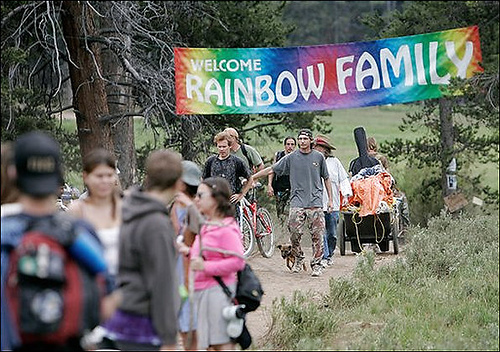
News footage showing the gathering around a roaring fire when there is a burning ban in effect doesn’t arouse a great deal of sympathy, and the media don’t o much to paint a positive picture of those traveling to join the host. There are legitimate concerns about the park resources being overwhelmed and about some of the folks being insanely unprepared for conditions at the northern end of Vancouver Island. The sad fact is that there aren’t likely a lot of communities hereabouts that would offer an alternative without some up-front money for services and damage deposits, funds unlikely to be forthcoming from the Rainbow Family. I guess, since this gathering won’t inject millions of dollars into the local economy, that most communities would rather they just not hold the gathering at all, even in the case where people might approve of some of the RF outlook. So BC Parks Service has closed Raft Cove Provincial Park and will station personnel on site to ward off any new arrivals. Cited as reasons for the closure were concerns about public safety, specifically that of the campers who seemed ill-prepared for the hardships they would face. There were also worries about damage to a sensitive local environment.

However, it might seem somewhat hypocritical of the authorities in light of what is a major part of the activity that sustains communities all up and down Vancouver Island, and the manner in which that business gets conducted (see below).


CC

The Town Isn’t The Only Thing Being Burned

Ring Of Fire

Ring Of Fire

MM&A today filed for bankruptcy protection. This is the legal was of the principals in a company walking away from the consequences of acts brought on by the actions of their company. This is the result of laws defining limited or non-public liability. The shareholders may or may not have done well with this outfit,I suspect management did all right, the railroaders probably made enough to get by, but perhaps not enough to be really committed to the job and the company, but the people of Lac Mégantic are going to be left holding the bag, along with the Province of Québec and the citizens of Canada as a whole. The whole system works in favour of the investing class and, unless criminal responsibility can be established, it seems reasonable to assume that the railroaders will be looking for work, the shareholders will get what value hasn’t already been sapped out of the corporate structure, and the mucky-mucks will join some of their other friends on another corporate management team. It seems unlikely that there will be much left to pick over by the residents, either through compensation or lawsuit, and I wish them the best of luck dealing with the insurance folk. Any time anyone who has worked in management says the words “transparency” and “accountability” you can bet that they are talking about what they get from others. Make no mistake, this ought to be construed on several levels as a criminal act, it’s just that there will be no culprit because the law forgives MM&A its trespasses before they’re ever committed, if I read the signs right. Read Greg Palast.


Update:


Please have a look at:

http://powellriverpersuader.blogspot.ca/2013/08/lac-megantic-survivors-get-victimized.html

A Sad Commemoration

Necessary?

Necessary?


Agugst 6, 1945:


Talk about your revised baselines, how about a world without nuclear weapons and the attitudes they represent. People will invent all manner of deviltry, often because someone else might otherwise do it first, and once something is invented, of course, it has to be tried, not just in the New Mexican desert, but, what the heck, let’s let it loose on a real city. What the heck, we’ve already firebombed Tokyo with a cool 100,000 casualties, why not go for the whole enchilada. Anyone less than 70 years old has lived his whole conscious life under this cloud, and we’re piling on even more disastrous potential with each passing year. There’s something seriously wrong, and we can’t seem to even contemplate the solutions.

Have a nice day.

The People Who Elect The Vultures

Buyer's Remorse? Likely Not.

Buyer’s Remorse? Likely Not.


I read this over at Owen Gray’s thoughtful site, a place where a great commentary seems to be forthcoming pretty much every day:

http://nor-re.blogspot.ca/2013/07/the-rise-of-spectacularly-incompetent.html


In this instance, our Prime Minister is appointing a man who has no diplomatic background to a diplomatic post. It would make sense to me that those entrusted with being the face of Canada in overseas missions would have undergone serious training and would have developed a deep fount of knowledge on world affairs, and particularly those aspects of diplomacy relating to the region in which they will be posted. That clearly seems not to be the case here and, unfortunately, the appointment seems to be just another incident where  Harper is keen to insert into appointed positions those who will be pliant tools of his own views rather than someone who represents something of a broader Canadian consensus view.

I’ve had discussions with various acquaintances and colleagues (when I was still working for a living) about political issues, particularly in the run-up to several and sundry Federal and Provincial elections over the last couple of decades. I have to stress that, while I agree with almost nothing of the politics of some of these folks, I respect them as good citizens, as good people, as people with a heart and a concern for others. In light of a whole series of incidents where the Prime Minister has proven himself to be a sly, devious, petty and controlling politician who works in the service of big money and the energy industry, I just have to wonder whether those who voted for Harper’s faux-Conservatives have any sense that they’ve been sold a bill of goods, that they didn’t get the moral and competent manager they thought they were getting, and that we are all poorer, less protected, more restricted and more misrepresented than at any time in the past. Mostly, I don’t think that the great mass of voters (a dwindling mass at that) really sees the sleaze that hides behind the flag-waging, support-the-troops, energy-superpower, it’s-all-about-the-economy rhetoric of the CPC machine. Incidents like this appointment are an incitement to get some of those good-folks voters together and to give every one of them a shake before asking them if this is what they really envisioned, and to they really care.


Against Forgetting: A Perspective from Derrick Jensen

What Life Was Like--For Some

What Life Was Like–For Some


The latest issue of Orion landed in my mailbox last week, the first paper issue I’ve seen in a couple of years, having switched to a digital subscription, and I was reminded of the pleasure of sitting down with a physical magazine, especially something as sumptuous as Orion, a visual feast as well as a wealth of content.  First up for me was a piece by Derrick Jensen called Against Forgetting: It’s hard to fight for what you don’t know you’ve lost.

His premise is that there has been a steady erosion of nature and the commons over the last several decades, to the point where there those of us who have become accustomed to the new reality and where there is at one generation and possibly two or three, who have known a whole different picture of society and its relation to the biosphere that what was extant in the middle of the last century.

Jensen writes of…

“,,,declining baselines. The phrase describes the process of becom­ing accustomed to, and accepting as nor­mal, worsening conditions. Along with normalization can come a forgetting that things were not always this way.”

As well, he cites Milan Kundera: “The struggle of man against power is the struggle of memory against forgetting.”

Much of Jensen’s discussion speaks to the disappearance of flora and fauna, to the loss of habitat and to the different nature of our interaction with the living world, though it could apply equally to the changed nature of relations within society. I would cite the state of health care as a prime example, on both sides of the Canada-U.S. border, with health care having become a profit center in the United States, subject to management by large healthcare corporations who insert a huge burden of bureaucracy and profit, as well as largesse to the management class, and stifling premiums for citizens, often with major exclusions from coverage and what seem to be denials of procedure on a whim. A look at an afternoon’s programming on an American television station will say much about the for-profit system: what advertising isn’t for cars, beer or casinos is likely to be for some health care organization. The same is true for the pharmaceutical arm of the health care equation, with a portion of the advertising being aimed at justifying the often outrageous cost of many medications because, we are told, these are R&D pharmaceutical companies. It seems, though, that advertising budgets are substantially larger than the budgets for actual research and development. North of the 49th parallel, we fare only somewhat better with the vestiges of what was once a reasonably competent nationwide health care system that delivered a wide variety of procedures in a timely fashion with relatively low overhead. Once Paul Martin took on the deficit pretty much on the backs of working Canadians by cutting services and transfer payments, the provinces were forced to cut back on what was on offer for patients, and, in many cases, did so with relish and glee, as governments turned a blind eye to the establishment of private, for-profit clinics and dismantled structures like the Theraputics Initiative, aimed at independent evaluation of pharmaceutical products and costs. When our current Prime Minister promised us that we wouldn’t recognize Canada when he got through, he wasn’t exaggerating or engaging in an idle boast, and our destination looks very much like the unregulated quagmire of our American friends and neighbours.

It is hard for us to maintain perspective and to measure change without a firm grasp of what used to be, particularly when, as individuals, we have access only to our personal and anecdotal information, and perceptions of how well the system functioned can vary considerably from place to place and with the influence of different circumstances, both personal and systemic. Sadly, it is hard for us to rely on statistics, given that there has been a campaign by several levels of government to ensure that the information that gets out reflect well on the issuing government, and on any interested parties with whom the government has chosen to work. Statistics Canada used to have a worldwide reputation as a quality provider of data and analysis based on thorough and meaningful methodology. My sense is that this is no longer the case, so we have to rely on our intuitive and personal understanding of whatever changes we perceive.

Changes of the same nature have been wrought in many other domains, from education to the world of work, from protection of water resources to urban sprawl, from foreign policy to basic research. The world I now inhabit is a very different world than that in which I grew up, and there is much that has been done that, for the sake of broader humanity and all the life that shares space with us, it would be better were it undone.

Jensen’s conclusion is an exhortation to gather baseline data now, a baseline against which to measure further erosion, or perhaps, rebuilding of the natural and societal realms, and he cites what might be some indicators to include in the baseline:

“But here is what I want you to do: I want you to go outside. I want you to lis­ ten to the (disappearing) frogs, to watch the (disappearing) fireflies. Even if you’re in a city—especially if you’re in a city—I want you to picture the land as it was be­ fore the land was built over. I want you to research who lived there. I want you to feel how it was then, feel how it wants to be. I want you to begin keeping a calendar of who you see and when: the first day each year you see buttercups, the first day frogs start singing, the last day you see robins in the fall, the first day for grasshoppers. In short, I want you to pay attention.

If you do this, your baseline will stop declining, because you’ll have a record of what’s being lost.

Do not go numb in the face of this data. Do not turn away. I want you to feel the pain. Keep it like a coal inside your coat, a coal that burns and burns. I want all of us to do this, because we should all want the pain of injustice to stop. We should want this pain to stop not because we get used to it and it just doesn’t bother us anymore, but because we stop the in­justices and destruction that are causing the pain in the first place. I want us to feel how awful the destruction is, and then act from this feeling.

And I promise you two things. One: feeling this pain won’t kill you. And two: not feeling this pain, continuing to go numb and avoid it, will. ”

All of this is too true, but not so self-evident that it has spurred legions of concerned citizens to action: the struggle of memory against forgetting can only be won when the dynamic tension between what is and what should gives rise to action.

However, there is another side to this.

No More
No More

Back in the early Sixties, we had one of these, though it was a convertible and a kind of a muddy gold colour. It was tricked out with an automatic transmission and power just about everything and was, in some circles, pretty typical of what was on the road at the time. The same with the house we haunted at the time, as seen in the header photo. It was easy to believe at the time that all was reasonably well with the World, and that whatever wasn’t right was going to be made right by our prodigious intelligence and will to make it right. It took decades to recover from the attitudinal fog that allowed us to continue unbridled consumption of goods and services as a way of life, but bits of it started to trickle through in the middle of the Sixties, and by the time Reagan was installed in the White House to begin his program of radical restructuring, there were glimmerings of awareness that we weren’t going to be able to carry on with “Fun, fun, fun ’til her daddy took the T-Bird away.” Somewhere it was written that living like there’s no tomorrow has turned from a lighthearted metaphor into a chilling impending reality, so the V-8 Ford is gone, in the sense that there are groups of people who have chosen to get off the bandwagon of He Who Dies With The Most Toys Wins, and to look for process to rebuild community, a rational economy and resilience, and to try to spread that message as a counterweight to the tsunami of consumerist messaging that permeates all levels of society. I would posit that we should also keep track of the seemingly meagre progress that we’ve made in eliminating the superfluous and harmful so that there is something to celebrate, but also as a way to measure what actions have been effective in preventing the further erosion of nature and society and contributing to reconstruction of a more just and sustainable model.

Bastille Day: A Long Story

Tricolore


My parents used to do something that might, in other circumstances, be considered rude, but might have been a necessary evil under the circumstances. My mother was one of the uppity women who actually had a college degree, and Dad, who bailed out of much of his formal schooling at fourteen or fifteen, had spent considerable time in France, so when they wanted to discuss something of weight in privacy, but were saddled with their considerable brood, they would just speak French and carry on the conversation with us trying to make some sense of what was going on. Dad, in particular, was a pretty serious francophile, particularly in terms of certain lifestyle issues, and this rubbed off on me to the point where, when offered the opportunity to learn some French in the latter stages of Grade 7, I leaped at the chance, even though it meant that I had to show up for school an hour early every day, and that there was no credit attached to the course. I carried this enthusiasm right through high school and eventually graduated from university with a degree in French Literature. After some kicking around trying out job options, I returned to university for a teaching certificate, and launched a career, now entirely in the rear-view of time, teaching mostly French at the secondary level. I generally found this rewarding and frustrating at the same time, and it certainly gave me an excuse to hone my language skills and cultural background by travelling in both France and Québec, by indulging in French television, radio and music, and continuing to read all manner of material from comic books to Jean d’Ormesson. I actually managed to incorporate a whiff of a lot of this stuff into the classroom routines to give students a sense that this wasn’t a hollow exercise in conjugating verbs and that an appreciation of one’s own culture required an outside reference point to be really effective (that was my line, and I still sense that it has some validity).

I guess the point of this is that there is a reason why I still pay attention to what happens in that far-off land, even though I don’t see myself going back. My sense was that there was a major current of progressive thought in much of the literature I studied, so of course I had the expectation that this would be something of an influence on how society functioned in France, even though I knew about the upheavals of decolonization and vicious undercurrents of fascism and reaction that have always acted as a counterbalance to any progressive leanings that might stir some portion of the population: ever the optimist in something of the Voltairian sense. Heck, they even have a Socialist Party and a Communist Party, and the Socialists have now elected a president for three mandates in recent memory, along with a stint with a Socialist Prime Minister from 1997-2002. Ah, but politics being what it is, we have what is known as a Socialist In Name Only, wherein Mitterand continued  pretty much the same policies as various conservative political formations have put forward over the decades, where Lionel Jospin admitted to lack of power to do anything when layoffs became standard operating procedure among profitable corporations, and where François Hollande, the current president and SINO, follows the EU austerity line, beggaring more citizens and further enabling the Medef and the hierarchy it represents. It’s a microcosm of what discourages people from voting. I listened to Mitterand, to Jospin, to Segolène Royal (PS candidate who lost to Sarkozy, the French Bush) and to Hollande. So much of what they said as candidates rang true, made sense, gave hope. They all crapped out, Mitterand blowing up Greenpeace vessels and dealing in all sorts of shady transactions in Africa, Jospin bowing to business as usual, Royal turning out to be a great friend to Tony Blair, and Holland betraying the mandate given to him by voters who had for too long been victims of the Sarkoziste pay to play system (so it would seem to an outsider). It seems rather like voting for Hope and Change, and getting Guantanamo six years on, the NSA in every box of cereal, drones all over, repeated corporate bailouts, cabinet posts dominated by Goldman Sachs, and a litany of failed policies leading to the point where there are almost as many people on Food Stamps as there are with legitimate jobs.

So I take this day to slurp some French Grape, eat the French national bird (raised in beautiful Beaver Creek, procured at the local Farmers’ Market from Bob) and ruminate somewhat on what could have been and what might still be, though the possibilities seem to narrow with each passing day.

So Rare, The Truth, The Whole Truth, Nothing But The Truth

What We Don't See (Ane Need To Look For!)

What We Don’t See (Ane Need To Look For!)


Recent discussions of the road vs. rail in the face of the possible construction of a gateway facility on the Alberni Canal are all valid, but they miss a couple of points, or fail to give them the focus needed. What has come to light is that there has been a lot of discussion of public business without the public being invited to the discussion, and it’s particularly disturbing that it took months for the information to come out via a Freedom of Information request, stalled on several occasions, delayed from August, 2012 until June, 2013. If we subscribe to the idea that justice delayed is justice denied, we are surely, as members of the public, being shortchanged on the flow of information on which to base decisions. Disturbing is, indeed, a term we might apply to much of what is being done in our names. In a business-to-business negotiation, it may be appropriate to withhold information from the seat opposite, but as soon as the public good is engaged in the discussion, there is a need for those little words that get bandied about so frequently without really meaning anything: open, transparent and accountable. It isn’t only a question of who pays (taxpayers), but also of who benefits and whether taxpayers get good value for money spent, of whether projects are worthy to begin with, and of the general direction of policy.  The obfuscation, delay and misdirection seems to happen at all levels of government, and the links between local, regional, provincial and federal governments seem to become increasingly tangled and the smokescreen increasingly universal. Taxes are good when they serve the community, but toxic when misdirected, and the only way to know the difference is through access to quality information, all of it, and in a timely fashion.