Solidarity?

tankpipe

(click on the image to read the Tyee’s article)

Throughout my working years I was party to discussions about the role of unions in relation to their members and to the community as a whole. Some felt that the advancement of the economic well-being was paramount in the union’s business to the exclusion of all else. Of course, this being a teacher union, there was also a faction who felt that the social climate was of concern, given that there is so strong a link between the conditions of the learning environment and the well-being of the teaching force, not to mention parents and the broader community.  The Tyee has a piece today about the concerns of unions relating to jobs in the energy sector, a discussion that may drive the wedge that separates economic and environmental well-being in the debate about the construction of energy infrastructure. The trade-off, in the eyes of the energy companies, as in the vast majority of government circles, is that we have to accept huge environmental  risks if we wish to have the prosperity that the export of dilbit and LNG would supposedly bring to our province. Thusly stated, the dichotomy is false and avoids the discussion of who “owns” the economy as well as highlighting the short-sightedness of those leading the discussion.


Had we chosen to be serious about jobs and energy, we would long ago have adopted the construction of infrastructure for renewable energy, using public funds as well as reworked taxes and royalties on fossil fuel development to set in motion a transition out of the era of environmental degradation and the rapid use of finite resources for the benefit of a small minority of the population, and into an era of the deployment and maintenance of all forms of renewable energy, paired with a truly effective recycling program that would obviate the need to extract much of the mineral wealth that is currently mouldering in landfills around the country. It would also be reassuring to see industrial production focused on truly durable goods, items made to last a lifetime and more, goods that, when broken, can be repaired and which, at the end of their useful life, can be easily recycled back into remanufactured replacements.


A quick look at economic gains made by unions might very well show that they are rapidly eaten up by inflation and by new taxes and user fees imposed by governments looking to reduce the load on their business constituency. Gains in working conditions and environmental concerns encourage broader hiring, keeping benefits in the local economy and social gains for society as a whole. We have to remember that the terms of economic discussion have, for decades, been set by a consensus of people schooled in and attached to the Friedman/University of Chicago group of free market freebooters, a group who barely manages to hold back the tides of discontent as they move us from crisis to crisis and who have produced as great a disparity of wealth distribution as has been known in recent history. They have also been the crew that dispenses the results of their efforts and have not spared the froth in letting us know what a brilliant job they’ve done for us, but there is so little truth in most of the reporting that it’s hardly worth the effort it takes to read it. The bar has been set so low that it wouldn’t be hard for us to do better, all the while keeping in mind that we want to still have an economy in mid-century and beyond. Our current course will lead to disorder and destruction, and unions can step up to help alter the course so that our children, grandchildren and later generations will be the beneficiaries of a decent living space and some equality of opportunity to participate fully in the business of society.

Some Wisdom Shows Through

tp-Web


“Economics is a form of brain damage.”
–Hazel Henderson (economist)
EW
The true civilization is where every man gives to every other every right that he claims for himself.
—Robert Ingersoll
These two people were guests on a forum from Boston organized by HuffPost: they are people who work within the current system, but who have drawn the wrath of much of the political class for advocating a return to some saner version of our current economic/social/political régime. Thomas Piketty got an earful from Kevin O’Leary, and it would seem likely that Elizabeth Warren scares the daylights out of even some of the Democratic caucus, as well as the entirety of everything farther to the selfish Right of the political spectrum. Why is that?, you may ask, when what these two are proposing is the rescue of our “civilization” from eating itself alive and taking much of life on Earth with it.  Fundamentally, they are proponents of redistribution of wealth in the opposite direction from what the Washington Consensus and the Reaganite/Thatcherite bunch have written as law in the post-New Deal/post-Great Society era, in effect the taxation of wealth beyond a certain level of absurdity, where wealth ceases to represent a comfortable living and starts to represent power across the spectrum of economics, social affairs and into the deepest recesses of politics and governance.
Piketty and Warren don’t necessarily have all the answers to all our ills, but the refreshing part of what they say is the reasoned openness of their critique of the corruption and misdirection of human affairs where the corruption becomes entrenched in the institutions that are supposed to serve society as a whole and where  moves are afoot to destroy the last vestiges of the commons, or the ability of society to come together to address the challenges that society has, by and large, created. This is evident in many spheres, but is particularly acute in the environmental field where the fossil fuel has drawn a verbal palisade around issues of energy, economy, and living space, including not only the buying of political influence, but the criminalization of revealing the nature of the damage being done by drilling, tracking, and mining of carbon fuel sources.
It would be nice if we had a special sandbox where the rich folk could hold sway and trade in luxuries as long as they didn’t encroach upon what the World needs to be doing to address inequality (especially inequality of opportunity) while the rest of us worked in a more constructive direction to rebuild a society where sense would be part of the commons and where we didn’t depend of stuff to define who we are. Sadly, the trade in luxuries tends to require an inordinate share of economic resources that will be needed to provide a decent standard of living for all of the rest of us.
Thanks to Crooks and Liars for the link to the HuffPo vid.

Even A Broken (analog) Clock (with a quick update)

Update: Heavens to murgatroid! I agree with something from the IMF! So here it is, via the Tyee.


…is right twice a day. ( I wonder if this means that we have, through digital clocks, lost half our accuracy.)


Subs

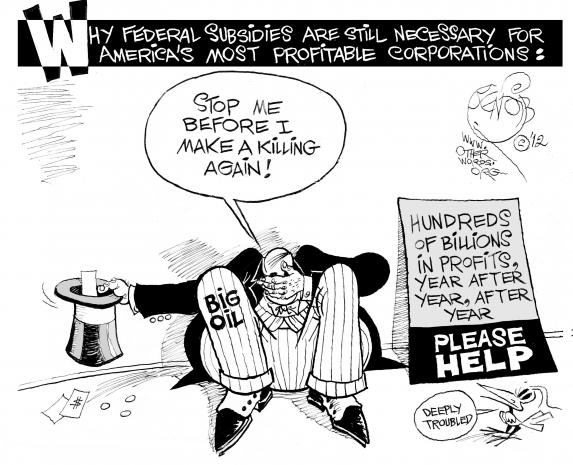
The broken clock/record, in this case, is the Fraser Institute, that tireless advocate of all who champion less government, mostly on behalf of wealthy and corporate sponsors. Yet an article posted in this morning’s Vancouver Sun makes at least partial sense when it chronicles the vast amounts of money paid out by three levels of government over the period from 1981 to 2009. The surprising statistic is that the total of subsidies over that period exceeds the current Federal debt, and outlines some of the yearly costs to taxpayers as well as showing that some of the most egregious offenders were corporations that were already well-established and profitable. It also doesn’t account for loans, often forgiven, such as the $457 million paid to GM to upgrade plant facilities in Ontario (this was well before the last major meltdown and bankruptcy protection/bailout for GM) or the awarding of perhaps-fatter-than-necessary contracts for infrastructure and IT. It does include marketing management schemes like the Wheat Board, and the indications are that all governments at both Federal and Provincial level are involved. It would be interesting to see how the Rae government in Ontario handled this file, as well as the Doer régime in Manitoba, Romanow in Saskatchewan, and the Harcourt/Clark crowd in BC. I’m sure that there are good reasons for subsidizing some sectors of the economy to shelter them from predatory practices in the marketplace, providing some protection of the general citizenry from the vagaries of a sometimes twisted and tortured free-for-all in the business world. However it also seems clear that there are many instances where pork barrels are the appropriate metaphor and where, clearly, taxpayers are not getting good value for their taxes. For the most part, the Fraser Institute, through generous subsidies from their supporters who then write these contributions off their taxes as a business expense or as, ahem, a charitable donation, generally falls squarely in the category of an enterprise supported by people it seeks to disenfranchise.

Generally, subsidies ought to be used sparingly and only when there is clear benefit to the broad majority of citizens. Few citizens realize that they are not only paying high energy prices at the retail level, but that they are also subsidizing energy concerns through tax breaks, free use of infrastructure, exploration write-offs, and direct subsidies, not to mention the insane current levels of government support and media attention for energy megaprojects. The sad fact is that energy is more expensive than we’ve come to think, and a large part of that cost has been hidden in the tax bundle that we fork out, wherein we get to purchase at least part of the product, whether or not we use it. The same is true of the products of many agricultural sectors, meaning that it seems outrageously expensive to buy local produce because the price in the market is so much higher than an “equivalent” from the supermarket, and a great deal of the difference can be accounted for by that portion that was handed out as subsidies, meaning that you are paying the supermarket and the CAFO whether you eat the stuff or not. I suspect that many would make different choices in many domains were they confronted with the real price of the seemingly-cheaper goods, and this reckoning doesn’t yet take into account the costs of health, safety and environmental considerations.

Finally, it seems likely that many of the côterie of free market proponents wouldn’t be so keen to support a market that was really free based on broad knowledge of the practices of both business and government.

Again, the prescient wisdom of Mose Allison…Stop this world, let me off, there’s just too many pigs at the same trough.

At least it’s (sort of) honest…

BWBW


Politicians of all stripes routinely skirt some of the more stunning moves they plan to implement if they get elected to office. I find it hard to praise someone whose program I dislike quite intensely, but it would be dishonest to refrain from tipping a hat to his seeming forthrightness, along the lines, in this case, of Grover Norquist (to my knowledge never elected to anything, but a huge influence on many who have been and who have made a valiant attempt to actualize GN’s thought) stating that he wanted to shrink government to the size of a baby so he could drown it in a bathtub. I speak of Tim Hudak, Conservative candidate for Premier of Ontario, who promises to cut 100 000 civil service jobs and to reduce corporate taxation by thirty percent if he becomes Premier. While this places him directly in the middle of promotion and defense  of and economic and social program that leads to complete collapse of all Earth systems, at least there is clear knowledge in advance for voters to consider in their choice. This has not been the case with, say, Stephen Harper, whose statements amounting to “trust me” conflict with his vague “you won’t recognize Canada when I’m through” statements when, in effect, he intends precisely what Hudak says he will do. Likewise, the case of our own provincial Liberals a dozen or so years ago, when Campbell and Company needed no policy statements to obliterate a stale and floundering New Democrat administration that tried to govern in a way that wouldn’t alienate the traditional business community rather than implement progressive economic and social policy. New Democrats had lied to themselves as well as to their constituents, and Campbell didn’t even need to lie. But lie he did, and his ministers and backbenchers alike, as to what their agenda was and as to the state of the province’s finances. The deception continues unabated pretty much everywhere and largely without regard to political, economic, or social orientation. John Horgan will perforce have to engage in massive tergiversation to get himself elected, I suspect, despite the contempt that so many have for the current régime, because the hard truth of our current straitened circumstances will be too much for the bulk of the electorate to stomach. Horgan may even believe that he can reconcile a vibrant energy sector with a fair deal of working folk and a program of environmental protection that can stave off disaster, but that would be inconsistent with everything we’re hearing from NOAA and IPCC, never mind the prophets of doom.


Just in case you didn’t catch all the lyrics, here’s a little helper so that we can appreciate the worth, in our present context, of something written decades ago. No, it likely wasn’t prescient, it’s just that things are even more Snafu’d now than they were back when our crises hadn’t become quite so acute.


If this life is driving
You to drink
You sit around and wondering
Just what to think
Well I got some consoloation
I’ll give it to you
If I might
Well I don’t worry bout a thing
‘Cause I know nothing’s gonna be alright
You know this world is just one big
Trouble spot because
Some have plenty and
Some have not
You know I used to be trouble but I finally
Saw the light
Now I don’t worry ’bout a thing
‘Cause I know nothing’s gonna be alright
Don’t waste you time trying to
Be a go getter
Things will get worse before they
Get any better
You know there’s always somebody playing with
Dynamite
But I don’t worry about a thing
‘Cause I know nothing’s gonna be alright

Silence Like A Cancer Grows

Much ado in broadcast media about the doubling of the price of Dungeness crab in local markets (haven’t been down to the Codfather to ask Max about it) and the fact that we’ve entered into the era of the $50 crab, shell on, live and kicking. The explanation comes from a booming export market in China. In a roundabout way, oil exports finance inflationary pressures on local food wherein we send dilbit to China, they use it for fuel and to manufacture CPSFC* that we all run to WalMart to stock up on and the Chinese entrepreneurial class use the proceeds from all this to buy up crabs (they apparently call them golden crab, ironically enough) and they have so much money that they can pay prices that take local food right off the menu for the rest of us. It’s a true manifestation of what a global market system can do for us. We have to hope that, even if it is the Chinese entrepreneurial class that’s chowing down on the crabs, the fishery is being managed for long-term survival, or maybe that doesn’t matter, given that the “perpetuation” of this way of doing things will kill itself and all of us with it. It occurs to me that crab shells are made from the same stuff as scallop shells, and might therefore be subject to the same environmental perils as local scallops who can’t make enough shell because of ocean acidification that might be tied to carbon dioxide in the atmosphere that might, in turn, be tied to the manufacture of CPSFC* linked to petroleum and its uses.

As is often the case, this reminds me of a song I first heard on a Mose Allison record long ago, but penned by Charles Brown. The reference is to the days three decades ago when, of a Friday, a pickup truck would roll up to the parking lot of the school where I was working (or, alternatively,  the school where my wife was working: they were close and on the route of said pickup truck) and fresh, live Dungeness crabs would be dispensed to buyers at the princely sum of $2.00 each. Home to cook, clean, and ice the beasts, toss a salad, whip up some home made mayonnaise or aioli, crack a chilled bottle of Muscadet and tear hunks off a loaf of crusty bread.


Life was good for some of us. It still is, for some of us, but the great leveller (somewhat selective) is progressively removing an increasing number of these pleasurable and nourishing experiences from our domain.

*CPSCF=Cheap Plastic Shit From China, a term I first saw on Northwest Edible. It’s really a generic term that applies to disposable goods of any material from any jurisdiction. Nobody would be too offended if Stuff were to be substituted for Shit.

Lily

This was the centrepiece at a recent “Day Away” for religious women, specifically Baptists, I think, but the theme is common and speaks volumes to the immobility of religious organizations on the multiple and deadly crises confronting us. Taken to its extreme, it results in the End Times attitude of “bring on the apocalypse” because God will know his own and look after them.

There are pockets of constructive activity in the religious community, but, as with most initiatives for sensible economic and social policy, they never quite seem to hit the mainstream, often simply because they don’t conform to the social inertia of the current main stream of  (dare I call it…) thought.

nuns-on-the-bus-540px

(the picture links to the article)

But the lilies attitude might as well be the same outlook as the famous icon of North American culture:


AEN


There are also the crowd that goes well beyond a happy-faced m’enfoutisme (a lovely French term for I couldn’t give a f***-ism), as outlined in a letter recently posted by Cousin Bill in far-flung Vermont:

Men and Their Sacred Writs

I’m not a biblical scholar but there is a wonderful passage in Matthew called “The Woes of the Pharisees and Scribes,” in which Christ – the son of God in Christianity, and a revered prophet in Judaism and Islam – excoriates the leaders of the church and state for their sins. I’ve updated it somewhat:

Who are these feared and fearful patriarchs, these lawgivers, and porers over sacred texts?

… Middle-Eastern elders who find in sacred texts the right to sell their daughters in marriage to their friends and then to hunt them down and kill them when they flee in terror,

… African elders who find in tribal tradition the right to ensure their infant daughters never grow up to know the passion of their gender,

… modern day Scribes and Pharisees, who themselves survived the worst genocidal annihilations of the last century along with the Romany, gays, Poles, and Slavs – who then seek in their sacred texts the right to subjugate their women and daughters and to ensure their hegemony in lands and territories,

… popes, cardinals, and priests who debate “how many angels can dance on the head of a pin” and find in their sacred tomes a pretext for preventing women from dispensing sacraments or having their say in the perpetuation of the race, who in the face of poverty jealously hoard their wealth and, when confronted with their own sins of child sexual abuse, bury evidence,

… Christians who mine the Bible, a writ of other men, to justify hierarchies of race and gender and disguise their own terror of the full range of human sexuality,

… And the Supreme lawgivers of our nation whose male majority find in their “originalist interpretations” of our Constitution:

–  That money is now free speech, even if the result is that the rich can now drown out the voices of the poor,

–  That corporate enterprises of men are, in fact, men themselves and have the same rights, even though corporations are innately amoral and aspiritual, lacking intrinsic art or ethics,

–  That our emerging oligarchy, a concentration of power and wealth that those who wrote the Constitution strove to prevent in their nascent democracy, is now a good thing.

We must ask ourselves if Mohammed, Christ, Buddha, Jefferson, and Maimonides and the other prophets and freethinkers about whom men have written and argued since language and story began were here today, would they endorse such interpretations and find them the fulfillment of their hopes for mankind?

Who are these fearful men? And, I must ask myself, am I one of them?

We can choose to act based on a notion of what’s the right thing to do, and that can be a powerful motivator, but there are also those of us who have somewhat more selfish reasons to protect a viable and just society working toward some semblance of ecological harmony. These are my grandchildren, I want them to have  a chance at a reasonable life, and what I want for them, I want for all people.

JJCB

Disturbing Outlooks and Attitudes #1

Hoax


I used to argue back and forth a decade ago with a sometime colleague who was an ardent supporter of George W. Bush, with he usual outcome that we would agree to disagree. I have since drilled down a ways into the current and developing status of humankind on this planet, and the auguries are not auspicious, to say the least. I was not at all comforted when said gentleman asked me at a gathering last evening whether I was looking forward to once again engaging in the breaking of speed limits for thrills, something I once undertook regularly with great relish, but gave up when it finally dawned on me that being a carbon critic who stunted on back roads for fun was not a particularly good example for others to follow. I answered him in the negative without much comment at all and was a little taken aback when he pursued his line by telling me that humans had no control over the course of the unfolding of the universe and that our best hope for survival and for thriving as a species was to decamp to the farther corners of the known universe, and that he would therefore continue to burn up resources at as rapid a pace as possible for his own enjoyment. This falls right in line with the Bill Gates geoengineering crowd, a group who doesn’t seem to understand that our living systems are more complicated, interwoven and subtle than our engineering minds can fathom, and that a look back at our witting on other interventions in managing our living space looks like a bit of a chronicle of disaster: particularly without a significant attitude adjustment and the development of both deeper and broader questioning strategies, our past would point to abject failure, this time on a scale that would basically be guaranteeing that we would, in short order, be kissing our behinds good-bye, taking the vast majority of life on the planet with us. This outlook speaks to a willingness to do whatever it takes to protect a position of privilege, and, as with most conservatives/libertarians, any justification is good enough as long as it allows life to continue on without sacrifice of the least bit of personal freedom or economic clout. The sad part is that we’ve known for decades how to manage most of the crises that confront us: we have had solutions that involve very manageable levels of sacrifice, usually balanced by long-term gain in well-being and stability. How very sad.

Burn


Meanwhile, here are a couple of music videos that caught my eye:


Looks like Green, Spencer, Kirwan, McVie and Fleetwood. Interesting that all the guitars get a voice at the front.

Perhaps one of the greatest studies in how to grow old gracefully. I think Taj is the only North American, the rest being Brazilians. Particularly nice harp playing.

Sometimes Evil People Speak the Truth

Or parts of it, anyway.

KO

I had one of those nights where I woke up and made the mistake of having a thought, and with thoughts, as with potato chips, one leads to another. Soon, I had wads of things flitting between my ears, and it was clear that I wouldn’t get back to sleep until I logged some time with book and early morning television, normally a great soporific. I saw a report about how lotteries in Canada are suffering because their best clients (milk cows) are old and dying off and that the current generation of Millenials, those in the 18-34 age bracket, aren’t playing with the gusto of the older folks. Of course, my own reaction is that this is a wonderful phenomenon and that I don’t feel a great deal of sympathy for those who run the gambling establishment in this, or any, country. Then, this being CBC Newsworld, there had to be an expert attestation: their expert on all things economic, Kevin O’Leary, about as sterling an example of anti-social greedmongerning as could be had anywhere, a man whose sense of entitlement and self aggrandizement grates against every fibre of my being. His take? Essentially, good on the Millenials for sussing out that lotteries, like most forms of gambling (stocks, bonds and mutual funds excepted) are taxes on the stupid. I hated that I would agree with KO on anything, and his undercurrent of tax avoidance  sealed the deal: KO wants us to fail miserably to support each other, to go it alone as rugged individuals so that the already-advantaged can use their financial and political leverage to perpetuate a system of gross inequity (and iniquity). Of course, the stupid factor was on full display with reports of an event honouring the real participants in The Great Escape, not Americans, and not Steve McQueen ( and who knew that Hollywood might rearrange the substance of a story to fit their hero cult) and a replay, several days delayed, of a nun singing some r ‘n b tune on an Italian version of some reality show, something of which I would have remained blissfully unaware were it not for the inordinate amount of “news” coverage that such a non-event got. Newsworld, all entertainment, all the time. How can Nancy Wilson keep a straight face as she reads this stuff (she was, in this case, the designated deliverer of good news, a task at which she has much company, unfortunately).

Guaino


Then there is Henri Guaino, now an elected member of the French National Assembly and formerly a special advisor to former President Nicolas Sarkozy, who was invited to answer questions on a segment of a Paris morning show (Télématin) called Les Quatre Vérités, with the hot topic being the outcome of the first round of the municipal elections. His rightish UMP did well, the current central government of François Hollande did generally poorly and the real “winner” seems to be the National Front, whose populist thuggish nationalism seems to have become a safe harbour for a lot of the protest vote. Bless Guaino’s pointed and selfish little head, he was able to spot that not only were the Socialists being sanctioned, but the whole political class was taking something of a beating for their unfulfilled promises to improve life for the general citizenry in France. Guaino cited in particular the surrender of the levers of power to the EU and to the financial and corporate structure (this from an individual very much in the house of those entities). I didn’t hear any real solutions (the segment lasts all of ten minutes), but the implication is clear that democracy, when it gives over power to economic interests and bureaucracies, is in serious trouble. Who knew.

mdAs a cap to all this, Murray Dobbin had a piece published in The Tyee this morning about big ideas and why the New Democrats seem to have lost some of their luster as they get more enthused about the idea of possibly forming a government (dream on!) and move toward the centre to attempt to capture that vote. In the end, the election of an NDP government might look more like a Pierre Trudeau government of the late Sixties than a real solution to the economic, environmental and social ills that beset us, so that the Dippers would have gained power, but would be unlikely to be able, or willing, to undertake the renewal that would lead us to a more just and equitable society.


Three Times A Fool

One for Syria, one for the Ukraine and one for Venezuela.


Stirring up the pot in the name of democracy where greed is the less apparent and root cause of the loosing of the hounds. Of course, it’s not the Henry Kissingers, Hilary Clintons, Angela Merkels, Dick Cheneys, and all manner of denizens of capitals wherever capital holds court who pay the price, either in terms of blood and despair, or in terms of austerity crashing down on opportunity and sanity. It’s the poor saps who started business  in the Maidan, in Damascus, and the poor of the barrios who will surely be stuffed back in their cages if the “middle class” privileged of Caracas regain the ascendency. So here’s another Otis Rush:


Tell me I’m ‘way off base, but it seems to me that Otis Rush’s All Your Love (Miss Lovin’) is the song that inspired Peter Green to write Balck Magic Woman, morphed into high-octane rock by Carlos Santana…


Every Once In Awhile

I like to revisit this ditty that often used to start off my week, a) because it’s about Monday mornings, and b) because it does have a tendency to engage the movement instincts (and really did when I was 17 or 18). The whole album is a masterpiece, and part of its charm comes from the meddling of Sam Charters, I suspect, who seems to have wanted to tone down some of Buddy Guy’s edgy and unbridled approach to playing: it’s not typical BG, but the restraint works well.

Of course, this misses the great news about the Oscars, the Heritage Classic and the end of the world, wherein Obama says to Putin: “I dog double dare you.” Putin says nothing, just goes ahead and deploys the troops. Well, what did you expect, Barry. Once again, an honest yearning for more local control and a better life has been hijacked by a group of local National Socialist types and reinforced by “diplomacy” from the EU and NATO. Ianukovitch and his lot should be gone, but when John Baird hies himself off to congratulate the newly installed administration (just who is it that rushes in?), you have to wonder which of the big miners is staking a claim. It’s what Canadians do. Again, rather like Assad in Syria, al-Sisi in Egypt, and whoever is running the show in Libya. Tunisia seems to be evolving, but who knows what goes on behind the scenes? Venezuela and Thailand are also targets for the “spokespeople” of the investor class, it would seem.


And, of course, this one always comes back: