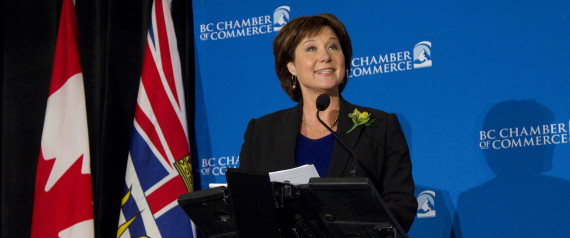
In a report released this morning, the Fraser Institute continues to build a legend around a theme of digging up novel methodologies for making reality fit their creed of greed (oh, and by the way, you don’t get any, but you don’t need to know that). The report ranks the provincial premiers on their fiscal acumen and, surprise, Christy Clark comes out as the winner. Please go read the whole thing as it encapsulates the decades of depredations occasioned by those who follow the tenets of this well-funded echo chamber of acolytes of the University of Chicago Economic Orthodoxy.
Isn’t it good to know that we’re number one at something other than the lowest minimum wage and the most child poverty?
When a newspaper dies, a community is lesser for it, opines Roy Macgregor over at the Globe and Mail, and I would tend to agree, but the timing of the dying is connected to the definition of death. As one who always loved the idea of a weekend morning ensconced on the couch with a pot of coffee and at least one fat weekend edition, it has been wrenching foregoing that often somewhat masochist pleasure, and even the occasion for a few pangs of regret when the daily five-minute scan or our local rag was abandoned for a bouquet of reasons (price hike, less content/more ads, unending editorial spew) and finally had a stake put through its heart when Black Press shut the paper entirely as summer faded into fall this past year. Then yesterday, there was a lot of wiling and gnashing of teeth as the Nanaimo Daily News faded to Black (whew!) after a run of 141 years, amply demonstrating David Black’s utter contempt for anything other than profits and hatred for unions.
Macgregor’s pronouncement has some truth in it, but the reason these papers died was apparent long before management chose to right-size the local paper industry: as I said to the subscription folks locally on a number of occasions that the paper had morphed into utter irrelevance. It died when it ceased to serve the needs of the community, and it’s only now when there is no “paper of record” that people in these parts wander around with blank stares wondering how it is that we don’t have a central organ to connect citizens with each other and with a semblance of knowledge on which to base some form of wisdom and discernement. It reminds me of (wait for it) a line from an old song that Paul Butterfield sang in 1968: “Your mind is leaving’, but your body’s staying’ here.”
By the way, closing small schools is a good way to rip apart rural communities, and, I’ll wager, urban neighbourhoods. This is David Black working from the same plan as our provincial administration in the quest to turn us all into industrial ciphers.
Actually, the is supposed to be good news, but, as is often the case, the joy or pain is related to how one views the subject.
This came up when scanning the Globe and Mail this morning, where Canada has been listed as the ninth least corrupt country in the world. I guess this is reasonable because we don’t have to deal with the level of garbage that happens in much of Africa, say, or the “Stans” (notwithstanding characterizations of Canada as Canuckistan), but with the B.C Rail deal, Site C, the Health Ministry Firings, Quick Wins, LNG, the Massey Tunnel replacement and everything else that just doesn’t smell all that clean, it would seem that someone missed something in this little corner of Canuckistan. Allison Redford showed us that our neighbours aren’t ready to let us steal a march on them, Kathleen Wynne is facing some sharp questions about her practices and those of her predecessors, and, certainly since the days of the Big O and the ’76 Olympics, there are few who would attribute lily-whiteness to Québec politics. For brevity’s sake, we need go no further, without even getting started with the Federal governments of many ages, in wondering if, since we’re so wonderful, how the hell does anyone get anything meaningful done anywhere else without a level of bribery and corruption that boggles the mind and bends the definition.
It’s a sad perversion of the idea of beauty being in the eye of the beholder and conjures up thoughts of the press saying anything it thinks would be cute, of ourselves being smug, and of a wilful ignorance on a grand scale.
For those whose French is a work in progress, the headline, from Libération, states that unfulfilled promises of reform kill the very idea of democracy. Of course, this is very true of the current administration of President François Hollande, as it is of Jean-Marc Ayrault and Emmanuel Valls, his two Prime Ministers, but it seems a recurring theme with governments both in Canada and abroad, and very much on point with current discussions of the signing of the Trans Pacific Partnership, where the meaning of the campaign slogan “Real Change” is shown for the hollow rhetoric that it is. Minister Freeland would have us believe that signing is not ratifying, but with a whipped majority and an ignorant electorate, ratification looks like a reasonably sure thing, showing to what extent the Liberal Party of Canada is in thrall to the same interests, if not exactly the same players, as the previous Conservative administration. Trudeau is looking increasingly like More Of Same rather than Real Change, in much the same fashion as the Hope and Change of 2008 morphed into Wall Street ever present in D.C., Guantanamo still open, another market bubble, increased wars and more carbon than ever pumping into the atmosphere. Is it any wonder why people seem reluctant to spend whatever minimal time it takes to get to the polls? It isn’t as though North America has a corner on the broken promises, given that the hope for a better future engendered by the formation of the EEC and then the EU has turned into a huge bureaucratic boondoggle and an entirely captured enterprise in the neoliberal mode. The rising tide of economic activity in Asia has failed miserably at making a decent life for most Asians, and Russia, post-USSR is a basket case with economic disparity on a level rivalling the Russia of the Tsars. The phenomenon occurs at all levels, not being restricted to national governments, as can be seen here in BC where our current administration wants to pull both triggers of the climate shotgun by giving pride of place to dilbit pipelines and LNG development, having first created conditions to ensure that none of the possible benefits stay here in BC.
Is democracy sacred? We look to find out fairly quickly whether its replacement will do better and creating conditions for inclusive well-being, a state that should be sacred.
“The illusion of freedom will continue as long as it’s profitable to continue the illusion. At the point where the illusion becomes too expensive to maintain, they will just take down the scenery, they will pull back the curtains, they will move the tables and chairs out of the way and you will see the brick wall at the back of the theater.”
― Frank Zappa
As last year(!) drew to a close, I found myself making like a BC Liberal flack and wearing out the <delete> key in my inbox. Both my wife and I, in our retirement, have taken it upon ourselves to be active in the community and beyond, in aid of creating a social and economic system that works on the principle of inclusion and that works toward a model of ecological regeneration, she from the standpoint of Christian obligation (as well as a generous nature), and I from the standpoint of a morality evolved through secular readings and observations. Our main focus is on our local community, which, it’s plain, is in need of an awakening to current circumstances and to a rebuild foundation for economic activity and reward, but she has ventured as far as Kenya with a women’s missions group, and we both maintain links to both national and international groups seeking to redress the worst (at first) of the world’s ills.
The sad parts that, once one has established a link to an organization, it seems that the relationship becomes one of lifetime support. My inbox has offered me more opportunities to donate in the last couple of weeks than I could ever hope to match, and there are many serial “offenders”, people who remind me several times daily about upcoming deadlines for tax receipts, or opportunities to meet matching donation quotas. The language has gotten progressively more florid as the deadlines approach, tugging ever harder at the heartstrings and guilt pangs to ensure the survival of each and every progressive social and ecologically-focused organization ready to vanish into the ether without my paltry donation.
I guess I can be a hard-hearted bastard when I need to: long ago, I learned to say a firm “No, thank you” based on the principle of being an active reader, seeker and link-follower. I can find the people with whom I need to connect to lend support and don’t need to be solicited with cold calls of one kind or another to prompt me, lest I forget to feed the machine: we do, of course, also get solicitations through Canada Post and via the phone, and my constant refrain when called upon, boils down to “don’t call me, I’ll call you: the best way to get left off the donations list is to ask.”
None of us can do it all, and it is precisely because we don’t seem to act in concert a good part of the time that concentrations of money an power find so ready a lever in the mechanisms of our current society, but I rue the day when we have a superstructure on the scale of the United Way for apportioning money donated to social, political and economic causes. Organizations of that nature seem to become self-focused and look after the organization itself before tending to the needs of the component causes. There is also a multiplicity of approaches that exist to deal with the inequity and iniquity of our current circumstances, some focused in the political realm, some purely ecological, some social initiatives, some squarely aimed at economic levers. I’m good at deciding where to put my time, money and words, and I don’t want people tugging at my sleeve at every corner, upsetting my internal harmony. I also know how fortunate I am in the circumstances of my birth, upbringing, career, cultural and social life, and to sense that my fortune should be everybody’s fortune, but please, a little decorum.
It’s not a knee-jerk to speak ill of the dead, but when we see the wave of only mildly restrained praise for Bill Bennett, the Mini-Wack, on the occasion of his passing, it raises a concomitant tide of bile over the lack of willingness to point out the influence that this “titan” had on the lives of British Columbians, as well as the downstream effects that his administration has had all across the country as part of the tide of trickle-down or supply-side economics that were very much coming into fashion during the reign of Bennett II.
Bennett was well-placed in 1975 to shovel dirt on the grave of the Barrett régime when labour turned on Bullchip Dave and the media of record were full of reports of the provincial economy coming apart at the seams, all of it directly attributable to the Barrett tax-and-spend, a social-worker-on-every-corner, communist-at-the-door reign of terror.
Bennett is being hailed as an architect of fiscal restraint, meaning that he set us on the road to privatization, the swiss cheesing of the social safety net, the comforting of the comfortable and the afflicting of the afflicted, and the environmental degradation of pretty much the whole province. Some of this came briefly into sharp focus during the turmoil of a possible general strike and the resulting sell-out by Jack Munro when, for a brief moment, there was a pretty clear picture of the number of the potential dispossessed and the possible power to be wielded through unity. Didn’t happen: cold feet, trust in false idols, lack of trust, Bennett was a clear winner, and we’ve (almost) all been losers ever since.
Bennett came from a position of privilege and did all to protect and enhance that position for himself and the small élite of his ilk, and he set a pattern for a succession of premiers who continued the good work of the Rockefeller Republicans. When a person makes life so much more difficult for so many people, any praise ought to be verrrry muted and couched in the context of the deeds done.
UPDATE:
February 1, 2016
Evidently, we’re not done praising Mr. Bennett. A memorial gathering was held this past weekend in Kelowna and much praise was heaped on the now-deceased Premier. I know this from hearing some tasty clips on CBC Radio’s On The Island, clips from a couple of my favourite people, Pattison and Spector, commenting that Bennett seemed tough, but that it was tough love and that he always had the interests of the people of BC at heart, in addition to which, he had a knack for telling the truth. Yes, yes he did care about keeping the people of BC in their place as contributors to the Pattison economy, and yes, yes he did tell the truth, exactly as dictated by folks like Pattison and Spector (Spector who worked tirelessly for the likes of Billy Bennett and Zalm, friend to Campbell and to that stirling example of moral rectitude, Brian Mulroney). These people are so generous that they would save us from the sin of greed by being taking on all the greed they can and showing us the true path of poverty and obedience. So now can we call it a day and let Bennett stay dead?
Pic is really from Dico Larousse and should be titled, I think, Je sème à tout vent.
The full title expression is:
Qui sème le vent récolte la tempête.
Check out France’s military and commercial interventions and it’s easy to see why Paris would be a target. The violence on both sides speaks to a failure of understanding, dialogue and diplomacy. Condemnation all around for said violence. Could last evenings events be part of the tempest of the above expression?
Also worth noting, perhaps, is the ongoing and increasingly pronounced inequality of opportunity and income that grips French society along with the rest for the Western World, and the World in general. The election of a Socialist government in 2012 has meant an extension of the same policies inflicted on the country by the neo-con/lib Sarkozy. Mitterrand taught us the same lesson. The impoverished tenement districts of many French cities are cesspits of crime, insecurity and despair, and fertile territory for the radicalization of young folks who see no future for them in society as it is presently structured.
Strange that Erica shared with me an article from Canadian Mennonite the other evening about a pastor noting that the sugar he put in his coffee in Hawaii had likely been grown a stone’s throw from where he sat, but that it had been shipped to the US mainland, processed, packaged and shipped back. He figured the little sugar packet had travelled some 16 000 kilometres before being dissolved into his coffee and returned through biological processing to its native soil. Wait, there is a link: this reminded me of the passage in Candide (Voltaire, 1759) about a runaway slave from a sugar plantation in the Caribbean area who was missing various parts of his anatomy because he tried to escape his servitude, and each time he did so, his master would remove a hand or a foot.
On nous donne un caleçon de toile pour tout vêtement deux fois l’année. Quand nous travaillons aux sucreries, et que la meule nous attrape le doigt, on nous coupe la main ; quand nous voulons nous enfuir, on nous coupe la jambe : je me suis trouvé dans les deux cas. C’est à ce prix que vous mangez du sucre en Europe.
…some get the sugar, some pay the price.
The Islamic State is a nasty bit of business, and it’s an easy decision to deplore the violence they have visited on Paris, as well as a litany of barbaric acts committed all over the Near East and beyond. But did no one take a moment to get François Hollande to reflect on the causes and effects of his adventures at home and abroad? When he ambles through the aisles at FNAC or Galéries Lafayette, does he never consider the notion of “You broke it, you bought it.”?
We live in a society exquisitely dependent on science and technology, in which hardly anyone knows anything about science and technology.
—Carl Sagan
The above citation speaks eloquently to the closing of libraries and the restriction of scientists’ contributions to ensuring that we have a livable planet and some creature comforts (like food, a sufficiently oxygenated atmosphere, quality drinking water, shelter, clothing, communications and all the other stuff on which society is based). It speaks to the claptrap that issues forth from legions of self-serving and greedy community “leaders” who want to continue blithely on with business as (what they deem to be) usual because it protects their position of privilege. It speaks to a wilful ignorance that allows for misdirection and malfeasance in governance at the corporate, local, municipal, state/province, national and international levels and to the trashing of the notion of an informed citizenry, a population not transfixed by the shenanigans of the beautiful people and the stunt men, by cat videos or by the next fix.
Those few who can and do invent, produce, deploy and maintain the systems on which we depend might end up forming a sort of high priesthood of Wizard-Of-Oz-like directors on whom we will all be blindly dependent. This reign might also be short-lived as the ignorant masses simply overwhelm the literate and send civilization to a tawdry end. The prospect is frustrating because of the unnecessary nature of the process and the loss of what could be a decent life for all.
Don’t argue with idiots: they’ll drag you down to their level and beat you with experience.
I went on social media this morning with the intention of, amongst other things, posting notice of a local meeting to investigate sponsorship of a refugee family, but found that there is something that really rankles about the idea. I’m an immigrant to Canada, and my forebears were immigrants from Germany and Ireland, some political and some economic refugees, and all this shuffling around has worked out pretty well for our lot, as well as for the receiving countries. Truth be known, everything I read indicates that it has worked out a damn sight better for us than for the original inhabitants of this land, and for many who haven’t been as successful at navigating the shoals of hostile economies and social situations as we have been. Much of this, both success and failure, can be ascribed to dumb luck, with Dame Fortune smiling on some and throwing stones at many more. A good deal more can be ascribed to the mean-spirited and short-sighted policy environment that has enveloped us in the last four or five decades and has (and continues to) caused disasters and misery abroad, discrimination and disparity at home.
My own sense is that there is a great need for rewriting our social and economic playbook, and that the care of our living space needs to be at the top of the list of priorities, and that charity is a band-aid on the festering sores of environmental degradation and the economic imbalance that produces poverty and homelessness, hunger, exposure and violence. As I suspect the case might be with many others who have avoided these pitfalls, we are charitable, but have the feeling that we could donate our way into our own poverty, and that it would make little difference in the overall scheme as those who have sequestered the great wealth of society in their own pockets would only deepen their own pockets of absorb the new donations without it making a whit of difference to the indigent. I reserve a special space in hell for people who fatten on the outpourings of charitable donations as part of the Charity Industry: it might be a good gig economically, but it’s morally indefensible. It’s also an excuse to let governments continue to funnel funds to their cronies and shirk responsibility to citizens for protecting our common living space, both physical and social.
Let’s accept refugees, welcome them with open arms and all the love and support we can muster. We have done much to create the conditions that forced them out of their former lives, so let’s try to make up part of it by ensuring that they have a better life here. At the same time, we here in Canada have a core of disenfranchised citizens, our own cadre of internally displaced persons, victims of whatever combination of toxic social circumstances and bad decisions by whomever. We can do better at looking after “our own” as well as taking in some “outsiders”, in the spirit of Gilles Vigneault’s Mon Pays:
De ce grand pays solitaire je crie avant que de me taire A tous les hommes de la terre ma maison c’est votre maison Entre mes quatre murs de glace je mets mon temps et mon espace А prйparer le feu, la place pour les humains de l’horizon Et les humains sont de ma race
(Basically, my house is your house, and all humans are of my race.)
Fairness doesn’t always dictate that everyone get the same treatment, but it ought to mean that no one goes without the necessities of life, including participation in society in economic, intellectual and spiritual dimensions, and full opportunity to improve the living situation, as long as it isn’t at the expense of others. So let’s sponsor both refugees from abroad and our own internal refugees. And let’s work toward a better economic and social balance at home, and quit blowing stuff up elsewhere.
I have an arts degree, specifically a major in French (primarily literature) with a minor in history (see Gary Larson’s comment above). Throughout my existence, I’ve seen references to people who do studies in the Humanities teased about the uselessness and frivolity of studies in this vein, and have disagreed somewhat vehemently on the basis of a perception that there is a major difference between education and training, and that the job that pays the bills is not necessarily the only focus of a person’s life. I was one of the fortunate folk who managed to find a career with my unmarketable skill: teaching kept me gainfully occupied for three decades, paying not only the bills, but providing a wealth of experiences for me to mull over looking at the interface between the Humanities and life in a logging town. Over the course of that career, I was able to maintain and pass along a sense of a broader perspective, one version of a vision where we might be capable of encompassing more than the simple generation of income and the dispersal thereof, a sense that there is more to see and do than just weather the Monday-to-Friday grind and the acquisition of a new truck. I learned that I ought not perhaps to be too judgmental about the relative merits of the various visions we all bring to the conversation, but work to see other people’s visions and to share my own as one of many. There were earlier iterations of this view that I was able to bring to the many other jobs I did before settling into the ongoing upheavals of a teaching career as well as to the upbringing of a couple of step children and some resultant grandfathering in which I presently engage, and I’ve always found it rewarding to encounter millwrights, engineers, fallers, plumbers, people of all stripes of careers, who have some version of breadth of vision, some through formal education, some through a simple personal propensity to question and read broadly.
The above video sums up much of my worries about how we view education and the resultant disdain for anything that isn’t of immediate utility in the workplace. This “know-nothing” treatment of learning leads potentially to the loss of perspective and knowledge akin to the destruction of ancient artifacts by religious extremists, people who will not tolerate parallel and sometimes conflicting world views, and where tolerance wilts, civilization follows. In part because of a lack of care and attention to our collective cultural treasury, this is where we appear to be headed, that is, to a society that isn’t social and a civilization that isn’t civilized.
This all came up because of a tweet from Alain de Botton, retweeted by Greg Blanchette.