Encore Redux

Yes, it’s like déjà vu all over again.


gc


Again, Gail Shea does the bidding of the Norwegians:


herring_venus


(Got this from the Powell River Pesuader)

Against the advise of her own DFO people and First Nations biologists and decision makers, Shea wanted to open up the West Coast of Vancouver Island and Haida Gwaii for herring roe fisheries. Her advice from other stakeholders was that there might be enough fish to justify a commercial opening, but that said opening might threaten the long-term stability of the herring population. This would open the possibility of a cod-like collapse in the herring population, something with which Shea ought to be quite familiar in her home turf: it would deprive First Nations of ceremonial and food fish (thereby degrading their cultural heritage as well as a source of healthful food), and would knock out one of the pillars of the survival of wild salmon. Of course, this would make a nice complement to expansion of net-pen fish farming on the coast as well as the increased support that taxpayers have been forced to give to an industry that operates against the interests of said taxpayers. It’s all part and parcel of a policy line that removes citizen control and access to what ought to he resources held and managed in common, and a good reason to choke on Shea’s title of Honourable Minister of Fisheries and Oceans.

In The Isolation Ward

olympic-rings


I had to leave the living room frequently over the last couple of weeks (it was beginning to look like a tart remark free-fire zone and snarkfest, mine all mine), and the weeks leading up to the last couple of weeks, and I’m gun-shy about turning on any broadcast media even now, lest I hear that taahh da-da-da-da  da-da-da-da  dum-dum-dum-dum and the stream of drivel that would follow, haloed with messages from Tim Horton’s and Molson’s, VISA, RBC, GM, McDonald’s and all the back patting and bonhomie that seems to accompany the least success in a major sporting competition. And now we’re into the post-mortem, picking over a corpse that wasn’t all that interesting in the first place.

There is also something of a sense of anticipatory dread stemming from the knowledge that the hype stream has already started for the World Cup this summer, the programs for which will barely have a chance to hit the recycling bin before we’ll hear the clarion of the trumpets signalling the barrage related to the next round of summer games.

The Russians admitted to $50 billion in expenditures for this round (check here for a point of view: who knows how real this is) . How much was spent by all those national teams in the lead-up to the actual competition, one might wonder, along with what a real reckoning of the disbursements for the Sochi installations. It would be interesting to compile a progressive equivalence list: what good could we have done with that money, material and effort were our empathic instincts less repressed?

Oh, and while we were so busy thumping our chests over our world domination in curling and hockey, the Ukraine passed from the hands of one set of oligarchs to a new/old set, Syria continues to be a warlord’s wonderland, Thailand is caught in a see-saw of interests similar to what transpired in Ukraine and the forces of evil are at work stirring things up in Venezuela. Our own deal leader went to misrepresent us in Mexico, then to sign away what last vestiges of democracy might still exist at a TPP meeting in Singapore, and his return will see the passage of an undebated Fair Elections Act that has about as much Fair as the Bush II. administration’s Clean Air Act had Clean in it. Our language is headed in the same direction as our ability to control our economic and political destiny.

Stay tuned. Or perhaps, even better, stay tuned out.


We Need To Do More Science (mild Irony)

gc


This is The Honourable Gail Shea, Minister of Fisheries and Oceans, Government of Canada, loyal Conservative and Harperite.

She was speaking at the Pacific Biological Station in Nanaimo yesterday on the addition of $54 million in research grants to the station’s budget, which really ought to be an expenditure to bring joy to our hearts. In support of the grant, Shea emphasized the need for the country to carry on additional scientific research on fisheries, and that certainly ought to be the case.

CTVVI News Report

Nanaimo Daily News Article

Problem number one with her grant is that it is directed solely at the expansion of aquaculture, specifically open-water aquaculture, of both shellfish and fin fish. The government’s program is clearly to support an industry that is largely controlled from beyond Canada’s borders and which, to say it mildly, is not without controversy. This grant will do nothing to lessen that controversy in that there are certain foregone conclusions inherent in the grant, those being that farmed fish are better for the economy than wild fish and that we should be fully invested as a people in net cage open water fish farming.

The first bit of irony lies in Shea’s statements that we need to do more science, this from a minister of a government that shuts down scientific libraries in the interest, on the face of it, of saving a rather paltry pittance in tax dollars. Shea chooses to ignore serious science in the public interest that indicated pretty strongly that fish farming, as it is currently practiced, harms habitat for a wide variety of sea life and threatens stocks of wild fish. The DFO has repeatedly rejected any results from any lab linking fish farming to the propagation of fish-borne viruses sea lice. This, of course, is very convenient for a couple of reasons, one being that it obviates the need for fish farming operations to be moved to dry land, and, secondly and of greater interest to the citizens of Canada, it allows for the degradation at least, and the disappearance at worst, of wild stocks. The degradation/disappearance of wild resources has a couple of benefits for the supporters of the Harper political/economic agenda: it turns the resource into a controlled commodity rather than a part of the biosphere to which all stakeholders have some access, and it removes the need to protect vast areas that have traditionally been protected as part of the salmon spawning régime, removing a significant set of obstacles for resource extraction. The science Shea wishes to pursue is the science of the foregone conclusion, that operates on the principle of perpetuating an ideological goal rather than discovering what all the implications are of the action contemplated.

My own sense is that the reports linked above both demonstrated another part of the tilted equation in that they tend to accept with little question the premise behind Shea’s announcement rather than giving sufficient time, space and credence to a well-documented alternative point of view. This wouldn’t be so much of a problem if so many people weren’t convinced that CVVI and the Nanaimo Daily News, along with the preponderance of the press organs, speak with the force of deep and broad knowledge. They don’t, they are press release channels.

Hence, the following quip from Woody Guthrie:

“I’d rather have the devil running my country than the screwbally bunch we got in most of our offices these days.”

Meanwhile, here’s a little object lesson from Delbert McClinton:

Perkins: The Real Program Leaks Out

The Deprived

The Deprived


Tom Perkins has come out with a couple of doozies the last week or so: wouldn’t it be great if his statements could be dismissed as the rantings of an overly rich fringe freak? His whine that the rich were being treated as the Jews were treated at Kristallnacht seems quite removed from reality in an era where the wealthiest of the Bush Bundlers were handed tax breaks over the long term to ensure that the invisible hand would have no meddling role in impeding their continuing accumulations of wealth, and where the “competent” authorities don’t seem to be able to muster the spine and resources to chase the trillions of dollars hiding in offshore accounts (according to certain sources). Alternet had the following:

Asked for an idea that could “change the world,” billionaire venture capitalist Tom Perkins told an audience at the Commonwealth Club in San Francisco on Thursday that Americans shouldn’t be able to vote unless they pay taxes and that the wealthy should have more votes.


In essence. what Perkins says is just the codifying of much of what has gone on in the process of de-democratizing what was at one time a fairly people-oriented society, as in about 1968, the date once cited as the high-water mark of democracy in North America (prosperity overall is said to have peaked in 1973, just prior to the Yom Kippur War and the resulting OPEC crisis). Various pundits of the privileged expounded in the lead-up to that point that we had a crisis in that society was becoming all to democratic and that steps would have to be taken to reverse that trend. In retrospect, a lot of it makes sense, and we may be in the end game even as I write with Stephen Harper pursuing the same kind of voter exclusion campaign waged by Harris in Florida in 2000 and Blackwell in Ohio in 2004. Another ploy is the OTAA gambit (Other Than As Advertised), a kind of bait and switch where the campaign rhetoric morphs, once the election is won, into practice that looks a lot like more of the same. Jean Chrétien’s Red Book was a sterling example wherein he would revoke NAFTA, axe the helicopter contract and reverse the GST. Of those, he managed to delay the helps, and, via the good offices of his Finance Minister and successor, Paul Martin, managed to “slay the deficit” along with the well-being of thousands of his constituents as the Feds cut services and transfer payments, often leaving junior levels of government to pass along the pain. We still have the GST and not only do we have NAFTA still hollowing out the economy and blocking any jurisdictional corrective measures, we are staring down the barrel of the next generation of “Trade” treaty, the TPP, which will extend the corporate hold over all economic processes and hence, the machinery of government. The other outstanding example of OTAA would have to be Barack Obama. whose pronouncements during the 2008 campaign spoke of redress for the ills of the Bush years, of a revelling and recalibration of the business of society, but whose actions have shown a continuation and even accentuation and acceleration of the same ponzi scheme perpetrated by GWB as well as his predecessors. LBJ comes out better on this scale than anyone in that office since, and largely because the general public at the time was in a mood that could best be described as truculent. Selfishness found its voice in his successor and discontent never has recovered the unity of purpose that moved the antiwar, human rights, and environmental movements to a position of prominence.

Recent decisions by the Supreme Court of the United States have unleashed the flood of money into political campaigns, in effect bringing forth a system much along the lines of what Perkins proposes, but we don’t call it vote rigging, we call it free speech, another of those perversions of language that hide the drive to return citizens to the status of serfs. The ongoing assault by the Harper Government on public institutions and on the commons in general fits right into this pattern, and another term in office will likely see out Dear Leader taking off the veil and instituting “reforms” based on his radial right-wing and religious fanatic beliefs, things that he hasn’t as yet felt emboldened enough to attempt. The militarization of law enforcement and the overreach of the surveillance apparatus are steps to enable to forcing of unpopular legislation  that will have been enabled by his thirty percent “majority”. Don’t like the prospect? Do something. Start talking now to your neighbours. Turn off the distractions like the Five-Ring Circus and spend some time working through steps to rebuild community. Either join a political party or start one, or scare the bejaysus out of all of them. But do something.

My Canada


MiddleOttawa to give IRS information on Americans living in Canada

Headline from the Globe & Mail, February 5, 2014


I am one of the million-strong contingent of American citizens living in Canada. I moved here in 1968 and have always resided here since that time. I spent one summer back in California in 1969 mostly, as it turns out, winding down some aspects of a social life that had run its course and was becoming irrelevant. Since then, I have made brief forays into the US, either to visit relatives and a few friends of increasingly long standing, or as part of an annual ritual motorcycle ride, a ritual that disappeared in the rear-view mirror of carbon consciousness a decade or so ago. I became a naturalized Canadian Citizen in 1974.

Due to a recent reinterpretation of US tax law, it turns out that I am delinquent in my filings for the IRS in the US, something to which I hadn’t given the slightest thought, not having generated any income in the US since I worked part-time in a gas station on the corner of Scott and Lombard Streets in the winter of ’67-’68. I did my university schooling here in Canada, worked a variety of part-time and summer jobs, always in Canada, and spent three decades toiling in the belly of the public education system, retiring to my office and garden almost eight years ago.

I don’t mind at all paying my fair share to support the common enterprise that is a nation and all the possible good it can do when citizens get together to provide the services that make life livable for all, and while I certainly don’t agree with much of the way the spending goes, particularly of late, I happily jump through whatever hoops are necessary to pony up what the law says I ought to: withholding at source ensures that I don’t often need to cut a cheque, but when that happens, I do so in the knowledge that I am fulfilling my responsibilities as a citizen, the price of the rights I am supposed to enjoy.

What I do mind, and what no one should have to go through, are unnecessary hoops and bureaucratic bumpf such as the IRS is now proposing, nay, demanding. OK, it’s the law, but we have to ask ourselves why the process can’t be streamlined in such a way that the process doesn’t need to be duplicated on two sides of the border. This is to catch people who are hiding income from the IRS to evade taxes. I don’t fall into that category. I don’t believe that the IRS has any claim to any of the income that I’ve generated in Canada over the last 46 years. Under the right circumstances, I would be happy to attach my Social Security Number to a declaration from Revenue Canada that I had no earnings subject to US taxes, and be done with it.  It’s clear that such will not be the process.

So the real pinch is that Revenue Canada is going to share my information with the IRS as a matter of policy. There are those who will posit that this is already happening, and that recent revelations of the actions of the NSA, CSIS, CSEC and who knows who else pretty much tell the tale that nothing that any of us does is cloaked from the broadly defined security establishment. This would certainly not have been the case when I first came to Canada, and there have been manifold occasions where the government of this country has more or less thumbed its nose at our neighbours to the south, particularly in instances where they weren’t being particularly good neighbours. Our current government is all of a piece with the corporate lobbyist-run show in DC, and, in fact, seems to be trying to outdo our American cousins at the game of enabling a Monopoly-style game of locking down the economy, and eventually all of society. I suspect that most Canadians have changed much less in this direction than their government, but the trend to intrusiveness and dishonesty is so widespread among those who direct our affairs that it seems to matter increasingly little what ethical positions might be held by the mass of Canadian citizens. Richard Newell, the infamous King Biscuit Boy out of old TO wrote a song that seems to characterize what’s become of our fair land: You Don Tore Your Playhouse Down Again


Competition

FreutschBags


Patronats français et allemands réclament un pacte de compétitivité européen

French and German Business Leaders seek an agreement on European competitivity

I suspect that competitivity is a word made up to describe the competitive nature of an economic unit in terms of labour costs, relative costs of inputs, costs relating to taxes and legal impediments to production and other assorted sticks that get stuck in the spokes of those wishing to make money. I have only heard (seen) it in French media, although I do seem to recall hearing competitiveness around these parts.

In France they have an organization called the Medef, whose equivalent in Germany is the BDI, a group made up of the representatives of the largest business concerns. Much of what they do is to lobby their respective governments on policy matters that affect their ability to do business in as unfettered a manner as possible.This event is like a mini-Davos, and, like Davos, they forgot to send me an invitation.

It isn’t that there aren’t political parties that clearly represent the interests of business and the people who live at that end of the economic spectrum: parties that actually represent the interests of working people are few and considered somewhat on the fringe of the political spectrum: France currently has a Socialist government that gets more of its policies from the Washington Consensus than from any serious socialist theory, a party that has gone the way of Tony Blair’s Labour Party and the Democratic Party in the US.

When these two organizations get together to discuss the competitive nature of business and government policy, we can be sure that they are less interested in competition than in ensuring that wages and benefits, environmental regulations and energy considerations are likely to be diverted to the benefit of the members of their respective organizations and will have little to do with the well-being of either of the countries in question, or of the European Union. Their idea of being competitive is paying workers on a Chinese or Bangladeshi scale, eliminating pensions and sick leave and defunding as much of the social safety net as possible. It begins to look a lot like a cartel.

If you wonder why there are so many strikes in France, in Italy, in Greece, Spain and  Portugal, this has something to do with it. François Hollande, as a candidate, was full of much of the same rhetoric as Obama the candidate. As presidents, they have turned out to be straw men for the commercial class and toxic to the interests of the greater population. The real wonder is that we don’t have more unrest here in North America.

(Original article tom Liberation.fr)

We Don’t Need No Stinkin’ Billionaires…

ToCourt

….’cause we got the government using the taxpayers’ coin to do the billionaires dirty work.

In a recent article on Znet, Gabriel Black describes a lawsuit being heard in California aimed at gutting protections for teachers and doing further damage to the state’s schools through further erosion of budgets:

On Monday, a trial began in Los Angeles County Superior Court that could eliminate teacher tenure in California and have national significance. It is part of a national campaign, led by the Obama administration and supported by both Democrats and Republicans, to victimize teachers for the crisis in public education.

Backed by a host of billionaires and politically connected lawyers, the lawsuit’s complaint cynically seeks to cloak a right-wing assault on teachers and public education under the mantle of securing the civil rights of students. Beneath the lawsuit’s pretense of concern for students is a well-planned initiative to dramatically reduce education costs.

In California, a tenured teacher can be fired for a variety of reasons ranging from “unsatisfactory performance” to “dishonesty” and “unprofessional conduct.” However, a teacher has the right to contest his or her firing and be reviewed by a three-person committee consisting of two teachers and a judge.

Beatriz Vergara, et al. v. State of California, launched by Students Matter with the backing of corporate executive David Welch, challenges the three California State Statues that allow for this hearing process. It also targets a statute that gives teachers the right to tenure and another statute requiring that less-experienced teachers be fired first when budget cuts are imposed.

The complaint alleges that “the challenged statutes have a disproportionate adverse effect on minority and economically disadvantaged students.” The complaint argues that “ineffective” teachers are disproportionately stationed in the schools of these minority areas with low-income earners. These students, they claim, are denied their civil liberty of having equal protection to an education.

The basic demand of those behind the lawsuit is to make it easy to fire more-experienced, higher-paid teachers. Los Angeles Unified School District (LAUSD) superintendent John Deasy, one of the first witnesses called, and an ardent supporter of the lawsuit, told the courtroom that firing was a drain on “human capital” and that it was “too expensive.” In the years leading up to the 2008 crash, the LAUSD successfully fired only between 3 and 6 teachers each year using the dismissal process. In the 2011-2012 year, the year Deasy took over, that number increased to a record 99 teachers.

Nowhere in the complaint is there any hint of the real causes behind the crisis of public education. In the past few years, California’s K-12 annual budget has been cut by about $18 billion. Thousands of schoolteachers have been laid off in California, and hundreds of thousands nation-wide. Throughout the country, teachers face classroom sizes of 50 or more students per teacher, with inadequate textbooks, supplies, and proper cooling and heating systems.

If this all sounds vaguely familiar, then you’ve been paying attention: ever since Gordon Campbell’s tax cutting’ posse moved into the Rockpile on Belleville, provincial revenues have been either curtailed or redirected toward those businesses friendly to the current régime. Recall that more than two billion dollars were immediately taken off the books in reduced business taxes and the parade has continued with monster savings all over the store as whole departments went to the private sector, public servants were shown the door and where it essentially became not only risky, but illegal for those toiling in the public interest to bargain for a reasonable share of the wealth in the best place on Earth.

When the Hole In The Rockpile Gang got a smackdown from the courts at the end of last month, it was clear that they wouldn’t be accepting the judge’s scathing rebuke and making amends for their sins if they could at least drag out the proceedings until they can make an immediate election issue out of it (they may yet do that), or somehow fiddle the process, as they appear to have done in the BC Rail Circus, so that they get the result they want. The BCTF pays its own lawyers: that money comes out of the pockets of he teachers themselves. The government’s layers are paid by thee and me, sorta like I get to pay for the ammunition so I can shoot myself in the foot, a process that rankles more than a little.

Fassbender and the rest of the Deputy Dawgs can’t let this go unchallenged. The cupboard probably is legitimately pretty bare after they’ve reduced oil and gas revenues (thanks Norm) and put on the Five-Ring Circus, complete with shadow-tolled highway, the Millennium Line, Delta Port, SFPR (sounds like something out of ancient Rome), nonsensical IPP contracts (unless you happen to be the IPP on the receiving end) and a couple bridges wherein there is a whiff of cozy relationships between government and winning bidders and little things like secret contracts (the list is not exhaustive, sadly). In truest Shock Doctrine style, they broke it, just hoping they couldn’t be called to account for their actions and inactions, so not only to they have to defend their dominance and nastiness, they have to ensure that no one can go back and scratch around to find out where the money really went, sorta like why we used to be able to afford stuff and somehow we can’t any longer.

Billionaire David Welch can go ahead and blow millions on his case: he gave the money to a foundation that will write him a tax receipt and he may just come out ahead, meaning that he would be using taxpayer money to sue the state, also using taxpayer money, to advance the cause of private education.

OK, I finally got smart and went around Znet’s organizational difficulties and found Black’s article. The end of the article outlines much of what is wrong with unions, and I would be quick to point out that the BCTF lies at the other end of the spectrum: they may not be perfect, but they have done a lot of heavy lifting on behalf of all the citizens of BC (Phil Hochstein notwithstanding) in a scenario where the well being of students aligns well with what the teachers’ union is championing.

This case will probably get settled with only seconds to spare before the world becomes uninhabitable.

Choice, No Choice

croatia-split

As a teen, I got dragged off to Europe, by my parents, for a number of reasons. Some of it was, I think, tied to the idea that the California way of living at the time (1966) was a bit of a gilded cage, and that the offspring could use a little perspective. This was not done lightly, and may have had a note of seeking refuge from the American commercial juggernaut. Whatever it was, there was a particularly interesting interlude of about a month when we crossed the border at Trieste into a (drumroll and dire music) Communist country, the Yugoslavia of the day. Tito’s Yugoslavia was something of a renegade in that there was some leeway for personal and community initiative and where parts of the country were more of a transitional zone between communist and capitalist parts of the world. There was a lot of tourist infrastructure, particularly along the Dalmatian Coast, with evidence that more was in the offing. By Western standards, it was insanely cheap, somewhat frugal, but the beauty of the place and the general warmth of the welcome lent some magic to pretty much the entirety of the month-long sojourn.

Most of our travel was in Croatia, with forays into Bosnia-Herzegovina and Slovenia. We never got into Serbia at all, but these divisions appeared less political and more ethnic and culture at the time, particularly to an outsider who didn’t speak any of the local languages. Encounters with locals rarely veered into the realm of politics or government: it was clear that people were not encouraged to debate the merits of Tito’s rule.

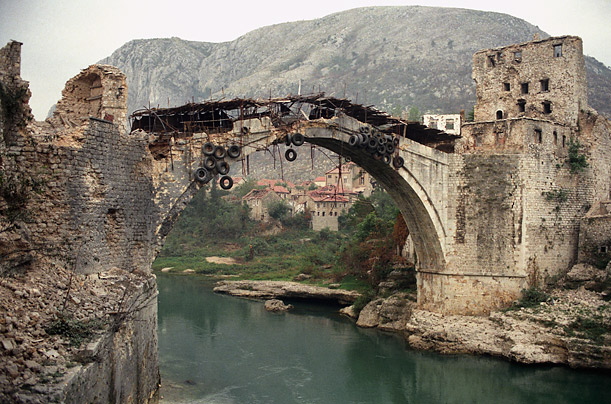
Mostar, when I was there, looked something like this:

Mostar

Mostar, in the midst of the post-Tito dismantling, looked something like this:


Tank Cannon Remodelling

Tank Cannon Remodelling

The horrors of the struggles in Bosnia, in Croatia and, eventually in Serbia are well-documented and a bit of a cautionary tale on what a combination of history, religion and ideology can unleash on entire populations. this was clearly a conflict where insanity prevailed and where there were no good choices, or at least the good choices never made it to the decision-making process.

It has often occurred to me over the last years, particularly in the wake of the Arab Spring, that it is often the case that what might be better choices are often not considered, and this fits in well with a current of thought stating that it would be mistaken to think that those who govern do so in the broader interest of the governed. Egypt seems torn between two utterly blind alleys, Libya is a total basket case and a cauldron of conflict, and Syrians, either wittingly or otherwise, have put themselves into the jaws of a vise where neither side presents anything other than repression and misery. The addition of meddling by Iran, by the Saudi clique, and by the Western clique only exacerbates the problem, prolonging the conflict and muddying the possibilities for resolution. Almost all the principals in these struggles are bad actors, often representing monied interests who are more interested in a dominant business model than in the resolution of a bloody and terrifying conflict. Assad is a bad actor, Morsi is a bad actor, Al-Sisi is a bad actor, Obama and the House of Saud are bad actors, as are the Mullahs in Iran and a host of other smaller fractious players working at the destruction of civilization.

Such also appears to be the case in the Ukraine, where factions aspiring to EU membership are in barely restrained warfare with other factions cleaving to old connections with Russia. No one speaks of a possible other course, favouring neither one not the other. The EU is a monster bureaucracy and an instrument of global capital. Russia is a bastion of corrupt dictatorship with some of the trappings of democracy: neither seems like a model that any sane person would want to emulate or with whom one would want to form close ties, and there may be good reason why the choice to not align never gets heard. As was the case with the original Orange Revolution (also the Rose Revolution in Georgia), there have been serious incursions of outside influence. Isn’t it stunning to hear Stephen Harper decry the lack of democracy in the Ukraine while he works actively to subvert and destroy what little is left of our representative parliamentary system here at home?

In an article published yesterday at CounterPunch (thanks to Murray Dobbin for circulating it), Eric Draitser puts the current situation in the Ukraine into perspective, enumerating the moves to co-opt a peaceful protest and escalate to violence and possible civil war. The Timoshenko/Ianukovich cleavage is well documented and, while presented as a battle of ideologies, it often looks more like a war of factions looking for dominant privilege. The only question left should be as to how to limit the damage done by both outside influences and by those in thrall to those influences, and then the consideration of whether, rather than choosing between Russia and EU, it might be of greater benefit in the long run to remain unaligned, where the best choice, given what’s on the table, is no choice at all.

Draitser’s article is well worth a read, both for what it says about Ukraine’s struggles, those of the Arab World, Greece, Italy, the EU, but also for lessons to be extracted in relation to governance slower to home.

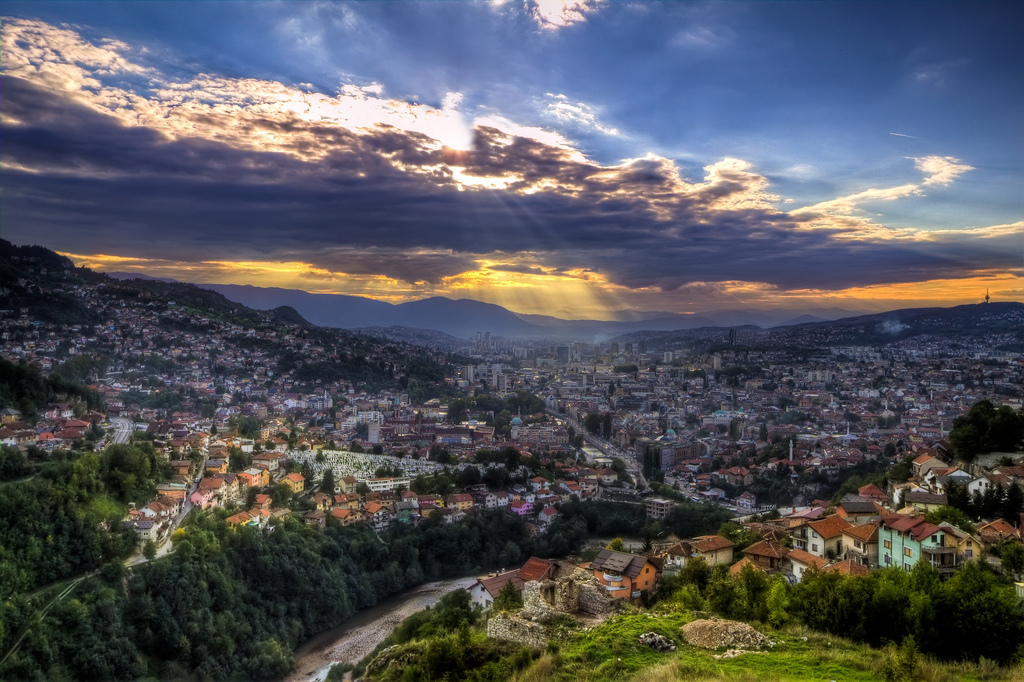
Lest this:

IMG_9127_5_6_tonemapped-3

…become this:

Sarajevo Post


Inappropriate Time and Motion

teacher-give-chance-to-students


Another piece cropped on the front page (Web) of the Globe and Mail yesterday about how teachers should be paid for performance rather than on seniority: I guess it had been too long since the Globe had taken a shot at teachers and at the public school system. Much of this grousing stems from the lack of desire on the part of those most endowed by out current economic system to pay for the enlightenment that should be the outcome of a thorough education for all, rather than just those students whose parents can afford to send them to Upper Canada College or Jean Brébeuf. It can also be the eagle stirring her nest, so that her young ones don’t get no rest (h/t Maria Muldaur for a 1974 recording of an old spiritual), meaning that we can’t let those fat-cat teachers get too comfortable.

Back in the early part of the last century, Frederick Winslow Taylor engaged in studies of industrial production, using time and motion studies as a way to building efficiency into the process of industrial production and refining the idea of measurable outcomes. It has become frequent practice to try to subject schools to the same process, usually by those who represent industrial output and who would like to defund the school system, or at least minimize it and bend it into a factory for productive labour. There are some flaws in the idea, and it’s interesting that the best debunking of the idea came from none other than Peter Senge at a conference in Victoria a dozen or so years ago. Senge was a business consultant and author whose ideas about changing business models found some favour in the late Ninties and early Oughts, but in this address to senior district administrators and ministry personnel, he had some choice thoughts for the gathering.


He compared schools to industrial concerns in terms of both input and output. In many production facilities, there are strict controls over the material on which the process is based, and material that doesn’t meet spec doesn’t get into the chain of production. All else is rejected. This, of course, doesn’t work well in a system of universal education, in which society undertakes to educate everyone’s children as opposed to selecting only the brightest and the best, or the most compliant, or the strongest, fastest, most adept.

Along the chain of industrial production, an enterprise will control as many factors as possible in the run-up to output so as to minimize deviation from spec and guarantee consistency of product at the end of the process. This is difficult for schools, given that the level of parenting will vary considerably, the presence of constructive/destructive influences outside the school system will vary widely, and the school system has call on the clientèle for only part of the day. During the other part, students are bombarded with images and messages as an incitement to consume and often actively encouraged by influences in the wider community to refrain from any exercise for their intellect. Unless there is serious intervention by the family or another agency, it is easy for any real education to stop at the school room door (the converse can also be true, where the dead air can happen in the classroom and where the student avails himself of opportunities outside of class to engage his faculties and pursue constructive interests, a necessary phenomenon when curriculum and delivery are dumbed down and strictly controlled within the school system). Again, in the industrial framework, any unit that doesn’t measure up along the production chain is simply flushed out of the system and ceases to be part of the responsibility of the organization. This is more difficult in the case of schools where the utmost effort must be made to retain all students in some part of the educational framework, lest they become part of the remediation/incarceration network.

Measurement of outcomes is difficult for schools. In the immediate aftermath of  public schooling, there are measures of how quickly students enter the job market or post-secondary education (and, eventually, the job market), as well as success at exit exams. These exams measure only a very limited and often mischosen set of outcomes and in a way that often means little or nothing. In the current economic climate, employment statistics are likely not going to be very good because of a dearth of real employment, particularly the jobs worthy of a career and where an exiting student might perceive the ability to build a life on the work on offer.

In addition, there is a serious quandary (not in some minds, I’m sure) about who determines whether a teacher is successful, about which teachers would deserve to be rewarded with merit pay and which teachers should be working for reduced salary because of shortcomings. A great deal  of personal preference and the arbitrary would be difficult to avoid. Fairness and justice in the distribution of benefit doesn’t seem to be one of society’s strong points, and the same can be said for a lot of individuals who have risen to positions of authority for reasons other than simple and demonstrated competence.

Finally, there is the matter of pay. Teachers will generally have spent five or six years learning their craft at university at their own expense. They will then spend eight to twelve years climbing up the salary scale until they reach their maximum. I would say that, by all means, we should remove the “seniority” clause: pay teachers the top salary from Day One. Teachers who are not competent need to be flushed out of the system if they can’t, given the opportunity, develop a series of processes and strategies that will result in success as an educator. But let’s also do the same with doctors, dentists, lawyers, judges, politicians, nurses, burger flippers, insurance sales people and the rest of the folks who toil on behalf of the general population. Teachers should do more of their training in the actual schools and should be paid to do that work, much as we do with apprentices in the trades and should access real salaries as soon as they get a position following successful completion of their training.

It is unfortunate that society has become so much a reflection of its industrial/consumer underpinnings: as a society, we are becoming increasingly unfit to judge the appropriateness of our institutions and incapable of bring the change to the institutions (as well as the creation of new or repurposed institutions) that the same society needs to thrive in the future. In the process of rebuilding our processes of education, a good first step might be the reform of the press and the cheap-shot journalism that produces screeds  such as the article that set off this whole rant.

Diplomacy

StevieBibi


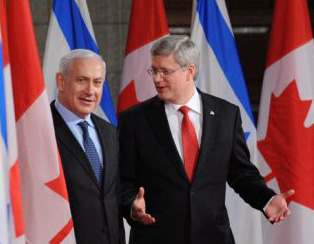
Our Dear Leader is off in Israel on a junket with dozens of people at taxpayers expense, off to once again swear undying allegiance to our favourite bullies. As a point of clarification, it bears stating that the part of Palestinian processes that involves suicide bombings and rocket barrages is wrong. However, the charade of Israel calling itself a victim as it continues to displace Palestinians, and the cynicism of holding the announcement of thousands of new settlement homes until after the departure of the American Secretary of State as well as the imbalance of military force in the region indicate that Israel is not, perhaps, the ideal state to hold up as a beacon of enlightenment and freedom as so often happens in the discourse of Harper, Baird and that lot. That Harper would offer the Palestinian Authority money to calm the waters speaks of either ignorance or goading as the gesture completely misses the point of a Palestinian state. It is likely, as is often seemingly the case, that the funds would be doled out by Israeli institutions, meaning that the bribe is also blackmail. If the Dear Leader wanted to be a real friend to the Israeli people, he might consider abandoning the blind loyalty to the current régime and support a viable peace process that would benefit both the Palestinians and the people of Israel.I seem to recall that a plan for such existed under the name Oslo Accords, but the process fell apart when Israel just kept on building settlements in land that was allocated to the Palestinians. That all happened twenty years ago, and the region looks no more peaceful now than it did in the run-up to the negotiations in Oslo.